reviews_and_ramblings: (Default)
2015-10-06 09:13 pm

Denton Welch & Eric Oliver

Maurice Denton Welch (March 29, 1915 - December 30, 1948) was born in Shanghai, to Arthur Joseph Welch, whose parents were English, and Rosalind Basset, whose family was originally from New Bedford, Massachusetts. Denton Welch was the youngest of four boys and spent his early childhood in Shanghai, with many visits to England. (Picture: Denton Welch, Self-portrait)

In 1924, Welch was enrolled in a school in Kensington, and then in 1926-1929 he attended St. Michael's, a preparatory school in Uckfield, Sussex. While he was in school, his mother, with whom he was especially close, died in Shanghai during March of 1927; this event had a profound effect on her son. In 1929 Welch started attending school at Repton in Derbyshire. Welch started at the Goldsmith School of Art in New Cross in 1933, where he studied for three years; among his teachers was the printmaker and graphic designer Edward Bawden. At first he lived in a house where his brother Bill was also rooming, and then he moved into a house near Greenwich Park where the landlady was Evelyn Sinclair, who became a close lifelong friend.

On June 7, 1935, Welch was traveling by bicycle to go visit his aunt, when he was hit by a car. His spine was fractured, and for a few months he was paralyzed from the chest down. He was able to learn to walk again, but with difficulty. For the rest of his life he had kidney and bladder infections, which would cause frequent severe headaches. After the accident, Welch first spent time at National Hospital, and then in the Southcourt Nursing Home in Broadstairs, Kent. When he left the nursing home July 1936, Welch rented an apartment with Evelyn Sinclair in Tonbridge in order that he could be close to his doctor, John Easton. He met his companion, Eric Oliver, in November 1943 while he was convalescing. Sinclair remained with Welch as his housekeeper at his different residences until May 1946, two months after Welch and his partner Eric Oliver moved to Middle Orchard, the country house of Noël and Bernard Adeney at Crouch, near Borough Green, Kent. However, Sinclair returned to Middle Orchard in July 1948 to assist Welch until his death. (Picture: Denton Welch, Cat Waiting For Its Master, ca. 1935–1948, Watercolor, pen, and ink on board, 13 5/8 x 9 1/16" (34.6 x 23 cm))


Denton Welch, portrait by Gerald McKenzie Leet, 1935
When Denton Welch left the nursing home in July 1936, after recovering from an accident knjury, he rented an apartment with Evelyn Sinclair in Tonbridge. He met his companion, Eric Oliver, in November 1943 while he was convalescing. Sinclair remained with Welch as his housekeeper at his different residences until May 1946, two months after Welch and his partner Eric Oliver moved to Borough Green, Kent. However, Sinclair returned to Middle Orchard in July 1948 to assist Welch until his death.


Read more... )

Source: http://research.hrc.utexas.edu:8080/hrcxtf/view?docId=ead/00242.xml

For nearly half a century Eric Oliver (born Bromley, Kent 6 October 1914; died Portslade, East Sussex 1 April 1995) basked in the reflected glory of having lived with the writer Denton Welch for the last four years of his life. (P: Eric Oliver in 1947)

Oliver was introduced to Welch in November 1943 at a time when Oliver, a conscientious objector, was working on the land and Welch was living as a semi-invalid, following a disastrous road accident when he was 20, near Hadlow, in Kent. "After you left the other night," Welch wrote to the painter Nol Adeney, "who should appear but Francis [Streeten, one of Welch's more eccentric acquaintances] and a new hearty land-boy friend! The land-boy kept suggesting that I should get up and go out and have a drink with him! As I was almost a corpse by then, I could not oblige." He elaborated in his Journals: "I tried to be very bright; but it was an awful strain. They had been drinking in a pub and had come on to me later. They were still mildly redolent of the pub and beer."

Despite Oliver's boozy and often hurtful conduct, Denton Welch fell in love with him. The intensity of Welch's emotions was not returned, for on his own admission Oliver was incapable of love ("You must never take me seriously," he wrote in the only letter of his to Welch which survives), but, once they had sorted out the imbalance in their relationship, Oliver moved in with him, and as Welch's physical condition deteriorated Oliver nursed him with practical expertise.

On the face of it, Eric Oliver seemed an incongruous choice of companion for a writer and painter as fastidious as Denton Welch. "It is just because you are different that I like you," Welch wrote to him in February 1944. "You wouldn't touch my imagination in the very least if you approximated more to my type." Oliver was virtually illiterate, and had little judgement about people, art or business. As Welch's residuary beneficiary on his death at the tragically early age of 33 (inheriting about £5,000), he appointed himself his literary executor, but parted with the copyrights of Welch's works to a bookseller who promptly resold them to the University of Texas. Oliver always maintained that he did not understand what he was signing.

Read more... )

Source: http://www.independent.co.uk/news/people/obituary-eric-oliver-1614132.html (Michele De-la-noy, Tuesday 04 April 1995, The Independent)

Days of Love: Celebrating LGBT History One Story at a Time by Elisa Rolle
Paperback: 760 pages
Publisher: CreateSpace Independent Publishing Platform; 1 edition (July 1, 2014)
Language: English
ISBN-10: 1500563323
ISBN-13: 978-1500563325
CreateSpace Store: https://www.createspace.com/4910282
Amazon (Paperback): http://www.amazon.com/dp/1500563323/?tag=elimyrevandra-20
Amazon (Kindle): http://www.amazon.com/dp/B00MZG0VHY/?tag=elimyrevandra-20

Days of Love chronicles more than 700 LGBT couples throughout history, spanning 2000 years from Alexander the Great to the most recent winner of a Lambda Literary Award. Many of the contemporary couples share their stories on how they met and fell in love, as well as photos from when they married or of their families. Included are professional portraits by Robert Giard and Stathis Orphanos, paintings by John Singer Sargent and Giovanni Boldini, and photographs by Frances Benjamin Johnson, Arnold Genthe, and Carl Van Vechten among others. “It's wonderful. Laying it out chronologically is inspired, offering a solid GLBT history. I kept learning things. I love the decision to include couples broken by death. It makes clear how important love is, as well as showing what people have been through. The layout and photos look terrific.” Christopher Bram “I couldn’t resist clicking through every page. I never realized the scope of the book would cover centuries! I know that it will be hugely validating to young, newly-emerging LGBT kids and be reassured that they really can have a secure, respected place in the world as their futures unfold.” Howard Cruse “This international history-and-photo book, featuring 100s of detailed bios of some of the most forward-moving gay persons in history, is sure to be one of those bestsellers that gay folk will enjoy for years to come as reference and research that is filled with facts and fun.” Jack Fritscher
reviews_and_ramblings: (Default)
2015-10-05 07:09 pm

Barbara Deming, Mary Meigs & Jane Verlaine

Barbara Deming (July 23, 1917 – August 2, 1984) was an American feminist and advocate of nonviolent social change.

Barbara Deming was born in New York City. She attended a Friends (Quaker) school up through her high school years.

Deming directed plays, taught dramatic literature and wrote and published fiction and non-fiction works. On a trip to India, she began reading Gandhi, and became committed to a non-violent struggle, with her main cause being Women's Rights. She later became a journalist, and was active in many demonstrations and marches over issues of peace and civil rights. She was a member of a group that went to Hanoi during the Vietnam War, and was jailed many times for non-violent protest.

At sixteen, she had fallen in love with a woman her mother's age, and thereafter she was openly lesbian. She was the romantic partner of writer and artist Mary Meigs from 1954 to 1972. Their relationship eventually floundered, partially due to Meigs's timid attitude, and Deming's unrelenting political activism.

During the time that they were together, Meigs and Deming moved to Wellfleet, Massachusetts, where she befriended the writer and critic Edmund Wilson and his circle of friends. Among them was the Québécois author Marie-Claire Blais, with whom Meigs became romantically involved. Meigs, Blais, and Deming lived together for six years.


Barbara Deming was an American feminist and advocate of nonviolent social change. She was the romantic partner of writer and artist Mary Meigs from 1954 to 1972. During the time that they were together, Meigs and Deming moved to Wellfleet, Massachusetts, where she befriended the writer and critic Edmund Wilson and his circle of friends. Among them was the Québécois author Marie-Claire Blais, with whom Meigs became romantically involved. Meigs, Blais, and Deming lived together for six years.


In 1976, Deming moved to Florida with her partner, artist Jane Verlaine. Verlaine painted, did figure drawings and illustrated several books written by Deming. Verlaine was a tireless advocate for abused women. Deming died in 1984. In 1975, Deming founded the The Money for Women Fund to support the work of feminist artists. Deming helped administer the Fund, with support from artist Mary Meigs. After Deming's death in 1984, the organization was renamed as The Barbara Deming Memorial Fund.

Read more... )

Source: http://en.wikipedia.org/wiki/Barbara_Deming

Marie-Claire Blais, CC OQ (born 5 October 1939) is a Canadian author and playwright.

Born in Quebec City, Quebec, she was educated at a convent school and at Université Laval. It was at Laval that she met Jeanne Lapointe and Father Georges Lévesque, who encouraged her to write and, in 1959, to publish her first novel, La Belle Bête (trans. Mad Shadows) in 1959 when she turned 20. She has since written over 20 novels, several plays, collections of poetry and fiction, as well newspaper articles. Her works have been translated into numerous languages, including English and Chinese. With the support of the eminent American critic Edmund Wilson, Blais won two Guggenheim Fellowships.

In 1963, Blais moved to the United States, initially living in Cambridge, Massachusetts. There, in 1964, she met her partner, American artist Mary Meigs. Marie-Claire Blais was working on her second and third novels, Une saison dans la vie d'Emmanuel and Les manuscrits de Pauline Archange. (Her first, La belle bête, rocked Quebec in 1959; Ms. Blais figures prominently in Mr. Wilson's 1965 book On Canada: An American's Notes on Canadian Culture.) Ms. Meigs began a tempestuous affair with Ms. Blais, and moved to Montreal in the mid-1970s; she and Ms. Blais lived with each other on and off over the next 15 or so years. Fluent in French, a respected painter -- she illustrated several of Ms. Blais's works, including Emmanuel and Pauline Archange -- and as Ms. Blais's long-time companion, she moved easily in both French and English artistic communities.

Read more... )

Source: http://en.wikipedia.org/wiki/Marie-Claire_Blais

Mary Meigs (April 27, 1917-November 15, 2002) was an American-born painter and writer.

Meigs was born in Philadelphia and raised in Washington, DC. She studied at Bryn Mawr College, and subsequently taught English literature and creative writing at that school. She served in the United States Navy's WAVES corps during World War II.

She subsequently studied art in New York City, and had her first exhibition of paintings in 1950.

Openly lesbian, Meigs met author Barbara Deming in 1954. Deming and Meigs became a couple and moved to Wellfleet, Massachusetts, where they joined a Cape Cod artistic circle that included abstract painter Mark Rothko, critic Edmund Wilson, and writer Mary McCarthy.

In 1963, Wilson introduced Meigs to Marie-Claire Blais, a writer from Quebec who became romantically involved with Meigs and Deming, and moved to Brittany with Meigs in 1972. The couple subsequently returned to Montreal, where Meigs spent the remainder of her life, in 1976.

Also in the 1970s, Meigs returned to writing, publishing books such as Lily Briscoe: A Self-Portrait (1981), The Medusa Head (1983) and The Box Closet (1987). In addition to her writing, she became a prominent spokesperson in Canada for lesbian, feminist and seniors' issues. She died in Montreal in 2002, following a series of strokes.


Mary Meigs, 1992, by Robert Giard (http://beinecke.library.yale.edu/dl_crosscollex/brbldl_getrec.asp?fld=img&id=1123973)
American photographer Robert Giard is renowned for his portraits of American poets and writers; his particular focus was on gay and lesbian writers. Some of his photographs of the American gay and lesbian literary community appear in his groundbreaking book Particular Voices: Portraits of Gay and Lesbian Writers, published by MIT Press in 1997. Giard’s stated mission was to define the literary history and cultural identity of gays and lesbians for the mainstream of American society, which perceived them as disparate, marginal individuals possessing neither. In all, he photographed more than 600 writers. (http://beinecke.library.yale.edu/digitallibrary/giard.html)
read more... )

Source: http://en.wikipedia.org/wiki/Mary_Meigs

Further Readings )

More LGBT Couples at my website: http://www.elisarolle.com/, My Ramblings/Real Life Romance
reviews_and_ramblings: (Default)
2015-10-04 10:21 am

Alain Daniélou & Raymond Burnier

Alain Daniélou (4 October 1907 – 27 January 1994) was a French historian, intellectual, musicologist, Indologist, and a noted Western convert to and expert on Shaivite Hinduism. He and his partner, Swiss photographer Raymond Burnier, whom he met in the early '30s, first went to India as part of an adventure trip, and they were fascinated with the art and culture of the nation. Daniélou and Burnier were among the first Westerners to visit India's famed erotic temples in the village of Khajuraho and Burnier's stunning photographs of the ancient temple complex launched the site internationally. The photographs were featured in an exhibition at the New York's Metropolitan Museum. (P: @Jacques Cloarec, Alain Daniélou)

Daniélou's mother, Madeleine Clamorgan, was from an old family of the Norman nobility; a fervent Catholic, she founded a religious order for women teachers in civilian costume under the patronage of St. François-Xavier. His father, Charles Daniélou, was an anticlerical Breton politician who held numerous national ministerial posts. One of his brothers was Roman Catholic prelate and Académie française member, Jean Daniélou. (P: Raymond Burnier at Zagarolo)

The young Daniélou studied singing under the famous Charles Panzéra, as well as classical dancing with Nicholas Legat (teacher of Vaslav Nijinsky), and composition with Max d'Ollone.


Alain Daniélou was a French historian a noted Western convert to and expert on Shaivite Hinduism. He and his partner, Swiss photographer Raymond Burnier, whom he met in the early '30s, first went to India in 1932, and they were fascinated with the art and culture of the nation. Daniélou and Burnier were among the first Westerners to visit India's famed erotic temples in the village of Khajuraho and Burnier's stunning photographs of the ancient temple complex launched the site internationally.


In Europe once more after nearly 20 years in India, Alain Daniélou found a large 11-hectare property for his friend, Raymond Burnier, at Colle Labirinto, Zagarolo, where Burnier came to live in 1958 after his divorce. Mrs. Burnier went on to become the international chairman of the Theosophical Society. In 1960 Alain Daniélou purchased two cottages on a much smaller piece of land, right beside the Burnier property. He only lived there permanently starting from 1980, when he retired.


Head of an apsaras. Mukteshvar Temple, Bhuvaneshvar. x century. Photograph Raymond Burnier-Copyright Pierre Beres

Read more... )

Source: http://en.wikipedia.org/wiki/Alain_Dani%C3%A9lou & http://www.find.org.in/alain-danielou/news/news/ (Jacques Cloarec – Translation by Kenneth F. Hurry)

Days of Love: Celebrating LGBT History One Story at a Time by Elisa Rolle
Paperback: 760 pages
Publisher: CreateSpace Independent Publishing Platform; 1 edition (July 1, 2014)
Language: English
ISBN-10: 1500563323
ISBN-13: 978-1500563325
CreateSpace Store: https://www.createspace.com/4910282
Amazon (Paperback): http://www.amazon.com/dp/1500563323/?tag=elimyrevandra-20
Amazon (Kindle): http://www.amazon.com/dp/B00MZG0VHY/?tag=elimyrevandra-20

Days of Love chronicles more than 700 LGBT couples throughout history, spanning 2000 years from Alexander the Great to the most recent winner of a Lambda Literary Award. Many of the contemporary couples share their stories on how they met and fell in love, as well as photos from when they married or of their families. Included are professional portraits by Robert Giard and Stathis Orphanos, paintings by John Singer Sargent and Giovanni Boldini, and photographs by Frances Benjamin Johnson, Arnold Genthe, and Carl Van Vechten among others. “It's wonderful. Laying it out chronologically is inspired, offering a solid GLBT history. I kept learning things. I love the decision to include couples broken by death. It makes clear how important love is, as well as showing what people have been through. The layout and photos look terrific.” Christopher Bram “I couldn’t resist clicking through every page. I never realized the scope of the book would cover centuries! I know that it will be hugely validating to young, newly-emerging LGBT kids and be reassured that they really can have a secure, respected place in the world as their futures unfold.” Howard Cruse “This international history-and-photo book, featuring 100s of detailed bios of some of the most forward-moving gay persons in history, is sure to be one of those bestsellers that gay folk will enjoy for years to come as reference and research that is filled with facts and fun.” Jack Fritscher
reviews_and_ramblings: (Default)
2015-10-02 12:09 pm

Charles de Sousy Ricketts & Charles Hazelwood Shannon

Charles Hazelwood Shannon R.A. (26 April 1863 – 18 March 1937), English artist, was born at Sleaford in Lincolnshire, the son of the Rev. Frederick William Shannon, Rector of Quarrington (himself the son of a Royal Navy Captain, Rodney Shannon and his wife Frances Nash), and Catherine Emma Manthorp, the daughter of a surgeon, Daniel Levett Manthorp (and his wife, Elizabeth Mason).

Shannon attended the City and Guilds of London Art School (then known as South London School of Technical Art, formerly Lambeth School of Art), and was subsequently considerably influenced by his lifetime partner Charles Ricketts and by the example of the great Venetians. In his early work he was addicted to a heavy low tone, which he abandoned subsequently for dearer and more transparent colour. He achieved great success with his portraits and his Giorgionesque figure compositions, which are marked by a classic sense of style, and with his etchings and lithographic designs. (Picture: Charles de Sousy Ricketts by George Charles Beresford)

The Dublin Municipal Gallery owns his circular composition "The Bunch of Grapes" and "The Lady with the Green Fan" (portrait of Mrs Hacon). His "Study in Grey" is at the Munich Gallery, a "Portrait of Mr Staats Forbes" at Bremen, and a "Souvenir of Van Dyck" at Melbourne. One of his most remarkable pictures is "The Toilet of Venus" in the collection of Lord Northcliffe. Several of his portrait works are on display in the National Portrait Gallery in London.


©George Charles Beresford (1864-1938). Charles Hazelwood Shannon and Charles de Sousy Ricketts (©4)
Charles Hazelwood Shannon attended the City and Guilds of London Art School (then known as South London School of Technical Art, formerly Lambeth School of Art), and was subsequently considerably influenced by his lifetime partner Charles de Sousy Ricketts and by the example of the great Venetians. Shannon became disabled in 1928 after a fall, and the neurological damage that resulted caused amnesia and ended his career.


The Toilet, 1912


Read more... )

Source: http://en.wikipedia.org/wiki/Charles_Haslewood_Shannon

more pictures and paintings )

Charles de Sousy Ricketts (2 October 1866 - 7 October 1931) was a versatile English artist, illustrator, author and printer, and is best known for his work as book designer and typographer from 1896 to 1904 with the Vale Press, and his work in the theatre as a set and costume designer.

Ricketts was born in Geneva to a French mother and an English father. He grew up mainly in France and Italy. He began his studies in art at the City and Guilds Technical Art School in Lambeth, in 1882, after both his parents had died.

According to William Rothenstein, "Ricketts, with his pale, delicate features, fair hair and pointed red-gold beard, looked like a Clouet drawing. Half French, he had the quick mind and the rapid speech of a southerner."

At the Art School he met Charles Shannon (1863–1937), painter and lithographer, who would be his lifelong partner in both his artistic and personal life. On the advice of Pierre Puvis de Chavannes, they settled in England rather than abroad.

They founded The Dial, a magazine, which had five issues from 1889 to 1897, and the Vale Press, named after their house, The Vale, in Chelsea, London. "The portrait of Ricketts by Shannon was painted two years after Ricketts had founded the Vale Press. It is a record of their friendship, slightly tentative in its character, with Ricketts turning his head away so that he is seen in profile. He liked it precisely for this reason since it shows him 'turning away from the 20th century to think only of the 15th.' It is labelled on the back 'The Man in an Inverness Cloak'." - National Portrait Gallery

Read more... )

Source: http://en.wikipedia.org/wiki/Charles_Ricketts


Recently sold, for 50$, on ebay this delightful ex-libris was designed for Joseph Gleeson White by Charles Ricketts - a more 1890s combination one couldn't really find. Gleeson White was the editor of The Studio, an editor and book designer for George Bell and Co., as well as a talented artist in his own right. He was part of a circle of the literatti in Christchurch in Hampshire in the 1890s which included Frederick Rolfe for a while.


Read more... )

Days of Love: Celebrating LGBT History One Story at a Time by Elisa Rolle
Paperback: 760 pages
Publisher: CreateSpace Independent Publishing Platform; 1 edition (July 1, 2014)
Language: English
ISBN-10: 1500563323
ISBN-13: 978-1500563325
CreateSpace Store: https://www.createspace.com/4910282
Amazon (Paperback): http://www.amazon.com/dp/1500563323/?tag=elimyrevandra-20
Amazon (Kindle): http://www.amazon.com/dp/B00MZG0VHY/?tag=elimyrevandra-20

Days of Love chronicles more than 700 LGBT couples throughout history, spanning 2000 years from Alexander the Great to the most recent winner of a Lambda Literary Award. Many of the contemporary couples share their stories on how they met and fell in love, as well as photos from when they married or of their families. Included are professional portraits by Robert Giard and Stathis Orphanos, paintings by John Singer Sargent and Giovanni Boldini, and photographs by Frances Benjamin Johnson, Arnold Genthe, and Carl Van Vechten among others. “It's wonderful. Laying it out chronologically is inspired, offering a solid GLBT history. I kept learning things. I love the decision to include couples broken by death. It makes clear how important love is, as well as showing what people have been through. The layout and photos look terrific.” Christopher Bram “I couldn’t resist clicking through every page. I never realized the scope of the book would cover centuries! I know that it will be hugely validating to young, newly-emerging LGBT kids and be reassured that they really can have a secure, respected place in the world as their futures unfold.” Howard Cruse “This international history-and-photo book, featuring 100s of detailed bios of some of the most forward-moving gay persons in history, is sure to be one of those bestsellers that gay folk will enjoy for years to come as reference and research that is filled with facts and fun.” Jack Fritscher
reviews_and_ramblings: (Default)
2015-09-26 10:00 am

Duncan Grant & John Maynard Keynes

David Garnett (9 March 1892 – 17 February 1981) was a British writer and publisher. As a child, he had a cloak made of rabbit skin and thus received the nickname "Bunny", by which he was known to friends and intimates all his life. Garnett was bisexual, as were several members of the artistic and literary Bloomsbury Group, and he had affairs with Francis Birrell and Duncan Grant. (P: ©Lady Ottoline Morrell (1873-1938)/NPG Ax140447. David Garnett, 1920 (©4))

A writer, he first met members of the Bloomsbury group in 1910 but was not fully accepted by them until 1914 when he became Duncan Grant's lover. Like Grant, Garnett was a conscientious objector and having worked in France in 1915 with the Friends War Victims Relief Mission, he worked as a farm labourer to avoid conscription on his return to England. Garnett moved with Duncan Grant and Vanessa Bell to Charleston farmhouse in 1916. He married Angelica Garnett in 1942. He was present at the birth of Grant's daughter, Angelica (by Vanessa Bell, and accepted by her husband Clive Bell), on 25 December 1918, and wrote to a friend shortly afterwards, "I think of marrying it. When she is 20, I shall be 46 – will it be scandalous?". When Angelica was in her early twenties, they did marry (on 8 May 1942), to the horror of her parents. 

Garnett was born in Brighton, the only child of the writer, critic and publisher Edward Garnett and his wife Constance, a translator of Russian. As a conscientious objector in the First World War, David worked on fruit farms in Suffolk and Sussex with his lover, Duncan Grant.


Duncan Grant and David Garnett, 1914, by Duncan Grant
David Garnett was bisexual, as were several members of the Bloomsbury Group, and he had affairs with Francis Birrell and Duncan Grant. A writer, he first met members of the Bloomsbury group in 1910 but was not fully accepted by them until 1914 when he became Duncan Grant's lover. Like Grant, Garnett was a conscientious objector and having worked in France in 1915 with the Friends War Victims Relief Mission, he worked as a farm labourer to avoid conscription on his return to England.

Read more... )

Source: en.wikipedia.org/wiki/David_Garnett

Duncan James Corrowr Grant (21 January 1885 – 8 May 1978) was a British painter and designer of textiles, pottery and theatre sets and costumes. He was a member of the Bloomsbury Group. (P: ©Lady Ottoline Morrell (1873-1938)/NPG Ax141304. Duncan Grant, 1922 (©4))

His father was Bartle Grant, a "poverty-stricken" major in the army, and much of his early childhood was spent in India and Burma. He was a grandson of Sir John Peter Grant, 12th Laird of Rothiemurchus, KCB, GCMG, sometime Lt-Governor of Bengal. Duncan was also the first cousin twice removed of John Grant, 13th Earl of Dysart (b. 1946).

Grant was born on 21 January 1885 in Rothiemurchus at Aviemore in northern Scotland. He attended school in England from 1894, where he was educated at Hillbrow School, a preparatory school in Rugby, and St Paul's School, London. Grant showed little enthusiasm for studying but enjoyed art classes. He was encouraged by his art teacher and also his aunt Lady Strachey, who organised private drawing lessons for him. Eventually, he was allowed to follow his desire to become an artist, rather than join the army as his father wished, and he attended Westminster School of Art in 1902. He then studied art at the Slade School and in Italy and Paris.

He was a cousin, and for some time a lover, of Lytton Strachey. Through the Stracheys, Duncan was introduced to the Bloomsbury Group, where John Maynard Keynes became another of his lovers.


Lady Ottoline Morrell; Maria Huxley (née Nys); Lytton Strachey; Duncan Grant; Vanessa Bell (née Stephen), vintage snapshot print, July 1915, 2 1/2 in. x 4 1/8 in. (62 mm x 104 mm) image size, Purchased with help from the Friends of the National Libraries and the Dame Helen Gardner Bequest, 2003, Photographs Collection, NPG Ax140432

Read more... )

Source: http://en.wikipedia.org/wiki/Duncan_Grant

John Maynard Keynes, Baron Keynes of Tilton CB, was the preeminent economist of the twentieth century. As an associate of the Bloomsbury Group, he enjoyed love affairs with painter Duncan Grant and psychologist Sebastian Sprott, and wrote love letters to writer Lytton Strachey. In fact, he was with Grant for nearly eight years and supported him financially even after they broke up. Keynes eventually gave up men and married ballerina Lydia Lopokova. (©International Monetary Fund. Assistant Secretary, U.S. Treasury, Harry Dexter White (left) and John Maynard Keynes, honorary advisor to the U.K. Treasury at the inaugural meeting of the International Monetary Fund's Board of Governors in Savannah, Georgia, U.S., 1946 (©8))

Attitudes in the Bloomsbury Group, in which Keynes was avidly involved, were relaxed about homosexuality. Keynes, together with writer Lytton Strachey, had reshaped the Victorian attitudes of the Cambridge Apostles: "since [their] time, homosexual relations among the members were for a time common", wrote Bertrand Russell. The artist Duncan Grant, whom he met in 1908, was one of Keynes's great loves. Keynes was also involved with Lytton Strachey, though they were for the most part love rivals, and not lovers. Keynes had won the affections of Arthur Hobhouse, as well as Grant, both times falling out with a jealous Strachey for it. Strachey had previously found himself put off by Keynes, not least because of his manner of "treat[ing] his love affairs statistically".

Keynes' friends in the Bloomsbury Group were initially surprised when, in his later years, he began dating and pursuing affairs with women, demonstrating himself to be bisexual. Ray Costelloe (who would later marry Oliver Strachey) was an early heterosexual interest of Keynes. In 1906, Keynes had written of this infatuation that, "I seem to have fallen in love with Ray a little bit, but as she isn't male I haven't [been] able to think of any suitable steps to take."


J.M. Keynes and Duncan Grant taken sometime prior to 1913 (©19)
Duncan Grant was a British painter and designer. He was a cousin, and for some time a lover, of Lytton Strachey. Through the Stracheys, Duncan was introduced to the Bloomsbury Group, where John Maynard Keynes became another of his lovers. He was in a relationship with Vanessa Bell. Duncan had many serious relationships with men, most notably David Garnett. In Grant's later years, the poet Paul Roche, whom he had known since 1946, took care of him and enabled Grant to maintain his way of life.

Read more... )

Stern, Keith (2009-09-01). Queers in History: The Comprehensive Encyclopedia of Historical Gays, Lesbians and Bisexuals (Kindle Locations 6971-6974). BenBella Books, Inc.. Kindle Edition.

http://www.charleston.org.uk/painters-model-and-poet-paul-roche/#sthash.Pg1wprr1.dpufDonald Robert Paul Roche (26 September 1916 – 30 October 2007) was a British poet, novelist, and professor of English, a critically acclaimed translator of Greek and Latin classics, notably the works of Aeschylus, Sophocles, Euripides, Sappho, and Plautus. Born in Mussoorie, India, Roche was an associate of the Bloomsbury group, especially of painter Duncan Grant, whom he met in the summer of 1946 and who lived with Roche and his family until Grant's death in 1978. (P: Paul Roche in the Studio at Charleston, by kind permission of Pandora Smith)

Duncan Grant was a British painter and designer. He was a cousin, and for some time a lover, of Lytton Strachey. Through the Stracheys, Duncan was introduced to the Bloomsbury Group, where John Maynard Keynes became another of his lovers. He was in a relationship with Vanessa Bell. Duncan had many serious relationships with men, most notably David Garnett. In Grant's later years, Paul Roche took care of him and enabled Grant to maintain his way of life. In 1958 Duncan Grant decorated the Russell Chantry at Lincoln Cathedral, using Roche as the model for Christ. In 1973 they travelled together to Turkey, resulting in the journal With Duncan Grant in Southern Turkey (1982). In 1975 they took a house and spent six months in Tangier, where Paul nursed Grant through pneumonia. Roche was made co-heir of Grant's estate. He was devastated when, in 1978, at the Roche household where he had come to live, Duncan Grant died of bronchial pneumonia at the age of 93.

Paul Roche used his translation of Sophocles', Oedipus the King, to write a screenplay for a film version of the work released in 1968 with Christopher Plummer in the title role. Roche played a small role in the Greek chorus.

Roche was ordained as a priest in 1943 but left priesthood in the 1950s. Marrried twice, he was a father of three children with his first and one with his second wife.

http://www.telegraph.co.uk/news/obituaries/1568663/Paul-Roche.html

http://www.christies.com/lotfinder/drawings-watercolors/duncan-grant-paul-roche-in-the-garden-5361869-details.aspx
Paul Roche in the Garden, by Duncan Grant, painted circa 1960s

Source: https://en.wikipedia.org/wiki/Paul_Roche

Walter John Herbert Sprott, known to friends as ‘Sebastian’ Sprott, and also known as Jack Sprott (1897–1971), was a British psychologist and writer.

Sprott was educated at Felsted School and Clare College, Cambridge, where he became a member of the Cambridge Apostles. In the 1920s, he became acquainted with other members of the Bloomsbury Group. He was romantically involved with the economist John Maynard Keynes, who was at the time also seeing the ballerina Lydia Lopokova. Sprott's affair with Keynes ended after Keynes married Lopokova. After a job as a demonstrator at the Psychological Laboratory in Cambridge, he moved to the University of Nottingham, where he eventually became professor of philosophy.


©Lady Ottoline Morrell (1873-1938)/NPG Ax142600. Dora Carrington; Stephen Tomlin; Walter John Herbert ('Sebastian') Sprott; Lytton Strachey, 1926 (©4)
Sebastian Sprott was a British psychologist and writer. Charm and wit and oratorical skill led him effortlessly into the magic circle of John Maynard Keynes's close friends; he became an intimate of E.M. Forster, who eventually made him his literary executor, and of Lytton Strachey. He regularly went riding with Keynes, accompanied him on a holiday to Algeria and Tunisia in 1921, and was probably his last male lover. This intimacy, though not the friendship, ended with Keynes's marriage to Lydia Lopokova in 1925.


Source: http://en.wikipedia.org/wiki/W._J._H._Sprott

Days of Love: Celebrating LGBT History One Story at a Time by Elisa Rolle
Paperback: 760 pages
Publisher: CreateSpace Independent Publishing Platform; 1 edition (July 1, 2014)
Language: English
ISBN-10: 1500563323
ISBN-13: 978-1500563325
CreateSpace Store: https://www.createspace.com/4910282
Amazon (Paperback): http://www.amazon.com/dp/1500563323/?tag=elimyrevandra-20
Amazon (Kindle): http://www.amazon.com/dp/B00MZG0VHY/?tag=elimyrevandra-20

Days of Love chronicles more than 700 LGBT couples throughout history, spanning 2000 years from Alexander the Great to the most recent winner of a Lambda Literary Award. Many of the contemporary couples share their stories on how they met and fell in love, as well as photos from when they married or of their families. Included are professional portraits by Robert Giard and Stathis Orphanos, paintings by John Singer Sargent and Giovanni Boldini, and photographs by Frances Benjamin Johnson, Arnold Genthe, and Carl Van Vechten among others. “It's wonderful. Laying it out chronologically is inspired, offering a solid GLBT history. I kept learning things. I love the decision to include couples broken by death. It makes clear how important love is, as well as showing what people have been through. The layout and photos look terrific.” Christopher Bram “I couldn’t resist clicking through every page. I never realized the scope of the book would cover centuries! I know that it will be hugely validating to young, newly-emerging LGBT kids and be reassured that they really can have a secure, respected place in the world as their futures unfold.” Howard Cruse “This international history-and-photo book, featuring 100s of detailed bios of some of the most forward-moving gay persons in history, is sure to be one of those bestsellers that gay folk will enjoy for years to come as reference and research that is filled with facts and fun.” Jack Fritscher
reviews_and_ramblings: (Default)
2015-09-24 07:36 pm

Jack Pierson, Mark Morrisroe & Brian Meola

Jack Pierson (born September 24, 1960, in Plymouth, Massachusetts) is a photographer and an artist. He studied at the Massachusetts College of Art in Boston. He was a boyfriend of famous American photographer Mark Morrisroe at the time Morrisroe lived in Boston. Pierson has made a name for himself with a body of work that includes photographs, collages, word sculptures, installations, drawings and artists books. His "Self-Portrait" series was shown in the 2004 Whitney Biennial and his works are collected by major museums worldwide. Jack Pierson’s “THE END OF THE WORLD“ opened on January 12th, 2013 at Regen Projects in Los Angeles. Brian Meola, artist and boyfriend, who works with Pierson to collect the displayed objects, described the process: “I’ve learned to understand the difference between just any sign letter and ones that are a part of a much richer history, that become even more than something lost or discarded. For example, the work A Triumph! contains bulb-lighted quotation marks and an exclamation point. Those were found in an abandoned heap behind an old sign company warehouse in Chicago. The factory had been closed for decades, soon to be torn down. These are some of the largest marquee letters Jack has found and used in his work. These most likely adorned the front of an old theater…” (Photo: Jack Pierson | VHI Contributors' Page S/S 11)

Jack Pierson currently divides his time between his home and studio in the Southern California desert near Joshua Tree National Park and New York. He has photographed many well-known celebrities and models, including Michael Bergin, Naomi Campbell, Snoop Dogg, Massimiliano Neri, Brad Pitt, and Antonio Sabato Jr.


Jack Pierson (born September 24, 1960, in Plymouth, Massachusetts) is a photographer and an artist. He was a boyfriend of famous American photographer Mark Morrisroe at the time Morrisroe lived in Boston. He is in a relationship with artist and collaborator Brian Meola. Jack Pierson currently divides his time between his home and studio in the Southern California desert near Joshua Tree National Park and New York. He has photographed many well-known celebrities and models, including Michael Bergin, Naomi Campbell, Snoop Dogg, Massimiliano Neri, Brad Pitt, and Antonio Sabato Jr.


Thursday Morning, Studio 7, Document (documentjournal.com), Spring/Summer 2013, Jack Pierson (Photographer), Victoria Bartlett (Fashion Editor/Stylist), John Tan (Casting Director) (http://models.com/work/document-thursday-morning-studio-7/145886)

Read more... )

Source: https://en.wikipedia.org/wiki/Jack_Pierson

Mark Morrisroe (January 10, 1959 in Malden, Massachusetts - July 24, 1989 in Jersey City, New Jersey) was a performance artist and photographer. He is known for his performances and photographs, which were germane in the development of the punk scene in Boston in the 70's and the art world boom of the mid to late 80's in NYC. By the year of his death he had 2,000 pieces of work to his name. (Picture: Self Portrait (to Brent), 1982, Mark Morrisroe)

Born to a drug-addicted mother, Morrisroe left home and began hustling under the name Mark Dirt at the age of 15. His mother was a tenant of Albert DeSalvo, the Boston Strangler, and Mark often told people he was DeSalvo's illegitimate son. When he was 17 years old, one of his disgruntled clients shot him in the back, leaving him with a bullet lodged next to his spine for the rest of his life. The experience had a profound influence on Morrisroe's art, which often incorporated images of young prostitutes and X-rays of his injured chest. Morrisroe attended the School of the Museum of Fine Arts, Boston, where he made friends with several soon-to-be-well-known artists, including Nan Goldin, David Armstrong, Philip-Lorca diCorcia, Stephen Tashjian (aka Tabboo!, with whom he founded the drag duo "Clam Twins" at the famous Pyramid Club in New York), Gail Thacker and Pat Hearn. His boyfriend while he lived in Boston was Johnathan Pierson, who later changed his name to Jack Pierson. He graduated from the Museum School with honors receiving the coveted "5th" Year" Award. While attending, he performed as a drag character of his own creation named Sweet Raspberry and co-founded a zine called Dirt Magazine with his friend Lynelle White, distributing it in Boston nightclubs. This zine was composed of fake news and gossip about celebrities, bands and other famous people, mostly from Boston.


Self-portrait with Jonathan
Born to a drug-addicted mother, Mark Morrisroe left home at 13 and began hustling at 15. The entirety of Morrisroe's brief life was characterized by danger and poverty, and mythologized by him. Morrisroe died in 1989. He is known for his performances and photographs, which were germane in the development of the punk scene in Boston in the 70's and the art world boom of the mid to late 80's in NYC. His ashes are scattered in McMinnville on the farm of his last boyfriend, Ramsey McPhillips.

Read more... )

Source: http://en.wikipedia.org/wiki/Mark_Morrisroe

Further Readings )

More Photographers at my website: http://www.elisarolle.com/, My Ramblings/Art

More LGBT Couples at my website: http://www.elisarolle.com/, My Ramblings/Real Life Romance
reviews_and_ramblings: (andrew potter)
2015-09-21 08:02 pm

Charles Henri Ford & Pavel Tchelitchew

Charles Henri Ford (February 10, 1913 - September 27, 2002) was an American poet, novelist, filmmaker, photographer, and collage artist best known for his editorship of the Surrealist magazine View (1940-1947) in New York City, and as the partner of the artist Pavel Tchelitchew.

Born in Brookhaven, Mississippi, he dropped out of high school and by age 16 he had started his first magazine, Blues(subtitled "A Bisexual Bimonthly"). Actress Ruth Ford (1911-2009) was his sister and only known sibling.

Not long after, he became part of Gertrude Stein's salon in Paris, where he met Natalie Barney, Man Ray, Kay Boyle, Janet Flanner, Peggy Guggenheim, Djuna Barnes and others of the American expatriate community in Montparnasse and Saint-Germain-des-Près. He went to Morocco in 1932 at the suggestion of Paul Bowles, and there he typed Barnes' just-completed novel, Nightwood (1936), for her.

With Parker Tyler, who would later become a highly respected film critic, he co-authored The Young and Evil (1933), an energetically experimental novel with obvious debts to fellow writer Djuna Barnes, and also to Gertrude Stein, who called it "the novel that beat the Beat Generation by a generation". The novel portrays a collection of young genderqueer artists as they write poems, have sex, move in and out of cheap rented rooms, and duck into the neighborhood's many speakeasies. The characters' gender and sexual identities are presented candidly; it was this candor which was reportedly the reason for its rejection by several American and British publishers. It was finally picked up by Obelisk Press in Paris.


Charles Henri Ford and Pavel Tchelitchew by Cecil Beaton
Pavel Tchelitchew was a Russian-born surrealist painter, set designer and costume designer. He left Russia in 1920, lived in Berlin from 1921 to 1923, and moved to Paris in 1923. In 1933 Charles Henri Ford traveled to Europe for the first time to meet artists and writers. In Paris he met Pavel Tchelitchew. Pavel, apparently dazzled by Ford, moved with Ford to New York City and thus began the stormy 26-year relationship that continued until Tchelitchew's death in 1957.


Charles Henri Ford [with Indra Tamang], 1989, by Robert Giard
Charles Henri Ford also had a long connection with Nepal, where he bought a house. He brought Indra Tamang, a young man of 21 from a Nepalese village, back to New York City to be his caretaker. Ford died in 2002. He was survived by his elder sister, actress Ruth Ford, who died in 2009. Upon her death, Ruth Ford left the apartments she owned in the historic Dakota Building on the Upper West Side to Indra Tamang, along with a valuable Russian surrealist art collection, making him a millionaire.Read more... )

Source: http://en.wikipedia.org/wiki/Charles_Henri_Ford

Read more... )

Pavel Tchelitchew (Russian Павел Фёдорович Челищев) (21 September 1898, Moscow - 31 July 1957, Rome) was a Russian-born surrealist painter, set designer and costume designer. He left Russia in 1920, lived in Berlin from 1921 to 1923, and moved to Paris in 1923. In Paris Tchelitchew became acquainted with Gertrude Stein and, through her, the Sitwell and Gorer families. He and Edith Sitwell had a long-standing close friendship and they corresponded frequently. In 1933 Charles Henri Ford traveled to Europe for the first time to meet artists and writers. In Paris he met Pavel Tchelitchew. Pavel, apparently dazzled by Ford, moved with Ford to New York City and thus began the stormy 26-year relationship that continued until Tchelitchew's death in 1957. (Picture: Pavel Tchelitchew, 1934, by Carl Van Vechten)

His first U.S. show was of his drawings, along with other artists, at the newly-opened Museum of Modern Art in 1930. In 1934, he moved from Paris to New York City with his partner, writer Charles Henri Ford. From 1940 to 1947, he provided illustrations for the Surrealist magazine View, edited by Ford and writer and film critic Parker Tyler. His most significant work is the painting Hide and Seek, painted in 1940–42, and currently on display in the Museum of Modern Art in New York City. He became a United States citizen in 1952 and died in Grottaferrata, Italy in 1957.

Tchelitchew's early painting was abstract in style, described as Constructivist and Futurist and influenced by his study with Aleksandra Ekster in Kiev. After emigrating to Paris he became associated with the Neoromanticism movement. He continuously experimented with new styles, eventually incorporating multiple perspectives and elements of surrealism and fantasy into his painting. As a set and costume designer, he collaborated with Serge Diaghliev and George Balanchine, among others. 

Read more... )

Source: http://en.wikipedia.org/wiki/Pavel_Tchelitchew  

more paintings )


Days of Love: Celebrating LGBT History One Story at a Time by Elisa Rolle
Paperback: 760 pages
Publisher: CreateSpace Independent Publishing Platform; 1 edition (July 1, 2014)
Language: English
ISBN-10: 1500563323
ISBN-13: 978-1500563325
CreateSpace Store: https://www.createspace.com/4910282
Amazon (Paperback): http://www.amazon.com/dp/1500563323/?tag=elimyrevandra-20
Amazon (Kindle): http://www.amazon.com/dp/B00MZG0VHY/?tag=elimyrevandra-20

Days of Love chronicles more than 700 LGBT couples throughout history, spanning 2000 years from Alexander the Great to the most recent winner of a Lambda Literary Award. Many of the contemporary couples share their stories on how they met and fell in love, as well as photos from when they married or of their families. Included are professional portraits by Robert Giard and Stathis Orphanos, paintings by John Singer Sargent and Giovanni Boldini, and photographs by Frances Benjamin Johnson, Arnold Genthe, and Carl Van Vechten among others. “It's wonderful. Laying it out chronologically is inspired, offering a solid GLBT history. I kept learning things. I love the decision to include couples broken by death. It makes clear how important love is, as well as showing what people have been through. The layout and photos look terrific.” Christopher Bram “I couldn’t resist clicking through every page. I never realized the scope of the book would cover centuries! I know that it will be hugely validating to young, newly-emerging LGBT kids and be reassured that they really can have a secure, respected place in the world as their futures unfold.” Howard Cruse “This international history-and-photo book, featuring 100s of detailed bios of some of the most forward-moving gay persons in history, is sure to be one of those bestsellers that gay folk will enjoy for years to come as reference and research that is filled with facts and fun.” Jack Fritscher
reviews_and_ramblings: (Default)
2015-09-19 10:28 am

Ethel Mars & Maud Hunt Squire

Edna Boies Hopkins, née Edna Boies, was born in Hudson, Michigan, and married Ohio artist, James R. Hopkins (1877-1969) in 1904. She studied at the Pratt Institute with Arthur Wesley Dow, at The Ohio State University, and in Paris. Dow was the first to develop Japanese printmaking without a key block. Ethel Mars and Maud Squire, later, were taught printmaking in Paris by life long friend Edna Boies Hopkins. Before in the mid 1890's the three women had been students in the Cincinnati Art Academy. (P: Garden Flowers, about 1915)

Although she was a painter, she is primarily known for print-making, specializing in color woodcut. She was a principle print-maker in the art colony which thrived in Provincetown, Massachusetts at the turn of the century. With her husband, she lived for extended periods in Paris during the formative years of European Modernism (1905-1914, 1920-1923). There Hopkins was an active member in various art and print-making societies, including the Société Internationale des Graveurs en Couleurs; Société Internationale des Graveurs sur Bois, and Société Nationale des Beaux Arts.


Edna Boies Hopkins, Mountain Women (aka Women in White), 1917

Source: www.kenygalleries.com/images/ah-hopkins-eb/ebhopkins-bio.html

American artists and life partners for more than 50 years, Maud Hunt Squire and Ethel Mars, forged distinguished careers in book illustration, painting, and woodblock printing. Émigrées to France, they frequented Gertrude Stein's salons and, during World War I, were among the Provincetown artists working in new methods of printmaking.

Maud Squire was born January 30, 1873 in Cincinnati. Her parents encouraged her artistic training, though both had died by the time she was a young woman. At the age of 21, she enrolled in the Cincinnati Art Academy and studied under Lewis Henry Meakin and Frank Duveneck. At the academy she met fellow student Ethel Mars, with whom she would live and travel for the rest of her life.

Mars, born in Springfield, Illinois on September 19, 1876, was the only child of a railroad employee and a homemaker. From 1892 to 1897, she studied illustration and drawing at the Cincinnati Art Academy.

Squire began her career while still a student, traveling to New York to meet with publishers and exhibiting her work. By 1900 she and Mars were living in New York City, traveling to Europe, and collaborating on illustrating children's books, such as Charles Kingsley's The Heroes (1901). By 1906 they had settled in Paris together.

Paris at the turn of the twentieth century had become a magnet for American women with artistic aspirations. As described by artist Anne Goldthwaite, Squire and Mars were prim "Middle Western" girls when they arrived in Paris. As such, they were expected to frequent institutions like Mrs. Whitlow Reid's "wholesome" club for young women, but as it turned out Squire and Mars found Paris's bohemian life more alluring. 


Maud Hunt Squire And Ethel Mars, by Maud Hunt Squire
American artists and life partners for more than 50 years, Maud Hunt Squire and Ethel Mars, forged distinguished careers in book illustration, painting, and woodblock printing. Émigrées to France, they frequented Gertrude Stein's salons and, during World War I, were among the Provincetown artists working in new methods of printmaking. Squire and Mars were the subject of Stein's whimsical word portrait "Miss Furr and Miss Skeene" (Squire's nickname was Skeene), written between 1909 and 1911.


Ethel Mars & Maud Hunt Squire are buried together in France. Together for over fifty years, they now share a simple grave in Vence.

Read more... )

Citation Information
Author: Pettis, Ruth M.
Entry Title: Squire, Maud Hunt and Ethel Mars
General Editor: Claude J. Summers
Publication Name: glbtq: An Encyclopedia of Gay, Lesbian, Bisexual, Transgender, and Queer Culture
Publication Date: 2005
Date Last Updated April 24, 2007
Web Address www.glbtq.com/arts/squire_mh.html
Publisher glbtq, Inc.
1130 West Adams
Chicago, IL 60607
Today's Date October 25, 2013
Encyclopedia Copyright: © 2002-2006, glbtq, Inc.
Entry Copyright © 2005, glbtq, inc.

Days of Love: Celebrating LGBT History One Story at a Time by Elisa Rolle
Paperback: 760 pages
Publisher: CreateSpace Independent Publishing Platform; 1 edition (July 1, 2014)
Language: English
ISBN-10: 1500563323
ISBN-13: 978-1500563325
CreateSpace Store: https://www.createspace.com/4910282
Amazon (Paperback): http://www.amazon.com/dp/1500563323/?tag=elimyrevandra-20
Amazon (Kindle): http://www.amazon.com/dp/B00MZG0VHY/?tag=elimyrevandra-20

Days of Love chronicles more than 700 LGBT couples throughout history, spanning 2000 years from Alexander the Great to the most recent winner of a Lambda Literary Award. Many of the contemporary couples share their stories on how they met and fell in love, as well as photos from when they married or of their families. Included are professional portraits by Robert Giard and Stathis Orphanos, paintings by John Singer Sargent and Giovanni Boldini, and photographs by Frances Benjamin Johnson, Arnold Genthe, and Carl Van Vechten among others. “It's wonderful. Laying it out chronologically is inspired, offering a solid GLBT history. I kept learning things. I love the decision to include couples broken by death. It makes clear how important love is, as well as showing what people have been through. The layout and photos look terrific.” Christopher Bram “I couldn’t resist clicking through every page. I never realized the scope of the book would cover centuries! I know that it will be hugely validating to young, newly-emerging LGBT kids and be reassured that they really can have a secure, respected place in the world as their futures unfold.” Howard Cruse “This international history-and-photo book, featuring 100s of detailed bios of some of the most forward-moving gay persons in history, is sure to be one of those bestsellers that gay folk will enjoy for years to come as reference and research that is filled with facts and fun.” Jack Fritscher
reviews_and_ramblings: (Default)
2015-09-17 09:29 pm

George Passmore & Gilbert Proesch

Gilbert Prousch, sometimes referred to as Gilbert Proesch, (born 17 September 1943 in San Martin de Tor, Italy) and George Passmore (born 8 January 1942 in Plymouth, United Kingdom) are two artists who work together as a collaborative duo called Gilbert & George. They are known for their distinctive and highly formal appearance and manner and also for their brightly coloured graphic-style photo-based artworks.

Prousch was born in San Martin de Tor in South Tyrol, northern Italy, his mother tongue being Ladin. He studied art at the Sëlva School of Art and Hallein School of Art in Austria and the Akademie der Kunst, Munich, before moving to England.

Passmore was born in Plymouth in the United Kingdom, to a single mother in a poor household. He studied art at the Dartington College of Arts and the Oxford School of Art.

The two first met on 25 September 1967 while studying sculpture at Saint Martin's School of Art. The two claim they came together because George was the only person who could understand Gilbert's rather poorly-spoken English. In a 2002 interview with the Daily Telegraph, they said of their meeting: "it was love at first sight". They have claimed that they married in 2008.


Gilbert Prousch (born 17 September 1943) and George Passmore (born 8 January 1942) are two artists who work together as a collaborative duo called Gilbert & George. The two first met on 25 September 1967 while studying sculpture at Saint Martin's School of Art. The two claim they came together because George was the only person who could understand Gilbert's rather poorly-spoken English. In a 2002 interview with the Daily Telegraph, they said of their meeting: "it was love at first sight".

Read more... )

Source: https://en.wikipedia.org/wiki/Gilbert_Proesch

Further Readings )

More Artists at my website: http://www.elisarolle.com/, My Ramblings/Art

More Real Life Romances at my website: http://www.elisarolle.com/, My Ramblings/Real Life Romance
reviews_and_ramblings: (Default)
2015-09-17 09:26 pm

Konstantin Somov & Mikhail Kuzmin

Konstantin Andreyevich Somov (Russian: Константин Андреевич Сомов, November 30, 1869 – May 6, 1939) was a Russian artist associated with the Mir iskusstva. Born into a family of a major art historian and Hermitage Museum curator Andrey Ivanovich Somov, he became interested in the 18th-century art and music at an early age. (P: Konstantin Somov (1869–1939)/Tretiakov. Portrait de Sergueï Vassilievitch Rachmaninov, 1925)

Somov studied at the Imperial Academy of Arts under Ilya Repin from 1888 to 1897. While at the Academy, he befriended Alexandre Benois, who would introduce him to Sergei Diaghilev and Léon Bakst. When the three founded the World of Art, Somov liberally contributed to its periodicals. Somov was homosexual, like many of the World of Art members.

Inspired by Watteau and Fragonard, he preferred to work with watercolours and gouache. For three years he worked upon his masterpiece, Lady in Blue, painted in the manner of 18th-century portraitists.

During the 1910s, Somov executed a number of rococo harlequin scenes and illustrations to the poems by Alexander Blok. Many of his works were exhibited abroad, especially in Germany, where the first monograph on him was published in 1909.


©Konstantin Somov (1869-1939). A Reclining Man (sold for US$790,378) (©4)
Konstantin Somov was a Russian artist associated with the Mir iskusstva. Somov was homosexual, like many of the World of Art members. On September 15, 1906, Mikhail Kuzmin depicts in his diary what was apparently his first sexual experience with more than one partner. The two happened to be a young man, Pavlik Maslov, Kuzmin’s lover at that time, and Konstantin Somov, Kuzmin’s close friend. On June 14, 2007, Somov's landscape The Rainbow (1927) was sold at Christie's for US$7.33 million, a record for a work of Russian art. 

Read more... )

Source: en.wikipedia.org/wiki/Konstantin_Somov

The Russian writer and translator Mikhail Kuzmin (October 18, 1872 - March 1, 1936) wrote poems and novels that present sympathetic, often idealistic, portrayals of gay love and desire. (P: Konstantin Somov (1869–1939). Portrait of Mikhail Kuzmin, from the Tretyakov Gallery (1909))

Kuzmin was initially attracted to theater and music. He developed his interest in theater early in life, attending operettas in Saratov, near Yaroslavl, where he was born. Kuzmin became a member of Nikolai Rimsky-Korsakov's music composition class at the St. Petersburg Conservatory in 1891, completing three years of the seven-year program, while also learning German and Italian.

During his life, Kuzmin translated writing not only from German and Italian, but also from English, French, Greek, and Latin, including works by Apuleius, Aubrey Beardsley, Lord Byron, and Johann Goethe, as well as 110 of William Shakespeare's sonnets and 9 of his plays.

In 1904, the homosexual Georgy Vasilevich Chicherin (1872-1936) introduced Kuzmin to Mir iskoustva (The World of Art), an artistic circle centered primarily on Sergei Diaghilev (1872-1929), best known for making the Ballets Russes a major influence in the European art world, and for his relationship with the dancer Vaslav Nijinsky.

The group attracted Kuzmin because of its theatrical concerns, its Art Nouveau aesthetic, and its relation to Symbolism. Mir iskoustva also appealed to Kuzmin because of its large homosexual membership and its penchant for dandyism.


Mikhail Kuzmin, 1919 portrait by his lover Yuri Yurkun
In 1910, Mikhail Kuzmin met his first major love, the poet Vsevolod Knyazev. In the same year, he published The Carillon of Love, a collection of poems written in the style of eighteenth-century pastorals and set to music by Kuzmin himself. Two years later, he published Lakes in Autumn, possibly the work by him that most idealizes homosexuality. Knyazev committed suicide in 1913, and Kuzmin met Yury Yurkun, also a poet, soon after. Kuzmin and Yurkun's relationship lasted until Kuzmin's death.

Read more... )

Citation Information
Author: Denisoff, Dennis
Entry Title: Kuzmin, Mikhail Alekseyevich
General Editor: Claude J. Summers
Publication Name: glbtq: An Encyclopedia of Gay, Lesbian, Bisexual, Transgender, and Queer Culture
Publication Date: 2002
Date Last Updated October 10, 2007
Web Address www.glbtq.com/literature/kuzmin_ma.html
Publisher glbtq, Inc.
1130 West Adams
Chicago, IL 60607
Today's Date March 1, 2014
Encyclopedia Copyright: © 2002-2006, glbtq, Inc.
Entry Copyright © 1995, 2002 New England Publishing Associates

Days of Love: Celebrating LGBT History One Story at a Time by Elisa Rolle
Paperback: 760 pages
Publisher: CreateSpace Independent Publishing Platform; 1 edition (July 1, 2014)
Language: English
ISBN-10: 1500563323
ISBN-13: 978-1500563325
CreateSpace Store: https://www.createspace.com/4910282
Amazon (Paperback): http://www.amazon.com/dp/1500563323/?tag=elimyrevandra-20
Amazon (Kindle): http://www.amazon.com/dp/B00MZG0VHY/?tag=elimyrevandra-20

Days of Love chronicles more than 700 LGBT couples throughout history, spanning 2000 years from Alexander the Great to the most recent winner of a Lambda Literary Award. Many of the contemporary couples share their stories on how they met and fell in love, as well as photos from when they married or of their families. Included are professional portraits by Robert Giard and Stathis Orphanos, paintings by John Singer Sargent and Giovanni Boldini, and photographs by Frances Benjamin Johnson, Arnold Genthe, and Carl Van Vechten among others. “It's wonderful. Laying it out chronologically is inspired, offering a solid GLBT history. I kept learning things. I love the decision to include couples broken by death. It makes clear how important love is, as well as showing what people have been through. The layout and photos look terrific.” Christopher Bram “I couldn’t resist clicking through every page. I never realized the scope of the book would cover centuries! I know that it will be hugely validating to young, newly-emerging LGBT kids and be reassured that they really can have a secure, respected place in the world as their futures unfold.” Howard Cruse “This international history-and-photo book, featuring 100s of detailed bios of some of the most forward-moving gay persons in history, is sure to be one of those bestsellers that gay folk will enjoy for years to come as reference and research that is filled with facts and fun.” Jack Fritscher
reviews_and_ramblings: (Default)
2015-09-16 08:56 pm

Pancrazio "Il Moro" Buciunì & Wilhelm von Gloeden

Baron Wilhelm von Gloeden (September 16, 1856 – February 16, 1931) was a German photographer who worked mainly in Italy. He is mostly known for his pastoral nude studies of Sicilian boys, which usually featured props such as wreaths or amphoras suggesting a setting in the Greece or Italy of antiquity. From a modern standpoint, his work is commendable due to his controlled use of lighting as well as the often elegant poses of his models. Innovative use of photographic filters and special body makeup (a mixture of milk, olive oil, and glycerin) to disguise skin blemishes contribute to the artistic perfection of his works.

Famous in his own day, his work was subsequently eclipsed for close to a century, only to re-emerge in recent times as "the most important gay visual artist of the pre–World War I era" according to Thomas Waugh.

Although von Gloeden claimed to be a minor German aristocrat from Mecklenburg, the von Gloeden family and its heirs have always insisted that no such person existed in their family records and his claim to The Barony von Gloeden was without warrant; the barony became extinct in 1885 with the death of Baron Falko von Gloeden. Wilhelm von Gloeden was the son of head forester (Forstmeister) Carl Hermann von Gloeden (1820–1862) and his wife Charlotte née Maassen (1824–1901; from 1864 von Hammerstein).

After studying art history in Rostock (1876), he studied painting under Carl Gehrts at the Kunstakademie in Weimar (1876–77) until he was forced by lung disease (apparently tuberculosis) to interrupt his schooling for a year, convalescing at a sanatorium in the Baltic Sea resort of Gröbersdorf. In a search for health, he travelled to Italy (1877–78), first staying in Naples before moving on to Taormina in Sicily. He lodged at the Hotel Vittoria before buying a house near San Domenico.


Il Moro
Baron Wilhelm von Gloeden was a German photographer who worked mainly in Italy. He is mostly known for his pastoral nude studies of Sicilian boys. In total, the Baron took over 3000 images (and possibly up to 7000), which after his death were left to one of his models, Pancrazio Buciunì, known as Il Moro (or U Moru) for his North African looks. Il Moro had been von Gloeden's lover since the age of fourteen. Most of the pictures are now in the Fratelli Alinari photographic archive in Florence.


Caino, 1902

Read more... )

Source: http://en.wikipedia.org/wiki/Wilhelm_von_Gloeden
In the 1870s, English art critic John Addington Symonds wrote about Michelangelo's and da Vinci's nudes, explicitly associating them with contemporary male-male desire. At the same time, in Sicily, German photographer Wilhelm von Gloeden began taking photographs of local young male peasants in "classical" poses. His work with clothed models garnered popular attention in Europe and America.
Von Gloeden's more explicitly erotic photos of nude males, many of them in sexually suggestive poses, also gained attention among American and European men who identified as lovers of men.
Read more... )
Most art historians agree that von Gloeden had sexual relationships with men and that Day, Eakins, and Sargent had romantic, if not physical, relationships with men. Women and men who desired their own sex had not found a significant level of freedom in America. But these female and male artists were able to live with a certain amount of visibility, with privileges the ordinary person did not have. --A Queer History of the United States by Michael Bronski
more photographs )

Further Readings )

More Photographers at my website: http://www.elisarolle.com/, My Ramblings/Art

More Real Life Romances at my website: http://www.elisarolle.com/, My Ramblings/Real Life Romance
reviews_and_ramblings: (Default)
2015-09-16 08:52 pm

Hannah Höch & Til Brugman

Hannah Höch (November 1, 1889 – May 31, 1978) was a German Dada artist. She is best known for her work of the Weimar period, when she was one of the originators of photomontage. (P: Hannah Höch self-portrait, c.1926)

Hannah Höch was born Anna Therese Johanne Höch in Gotha, Germany. In 1912 she began classes at the School of Applied Arts in Berlin under the guidance of glass designer Harold Bergen. She chose the curriculum glass design and graphic arts, rather than fine arts, to please her father. In 1914, at the start of World War I, she left the school and returned home to Gotha to work with the Red Cross. In 1915 she returned to school, entering the graphics class of Emil Orlik at the National Institute of the Museum of Arts and Crafts. Also in 1915, Höch began an influential friendship with Raoul Hausmann, a member of the Berlin Dada movement. Höch's involvement with the Berlin Dadaists began in earnest in 1919. After her schooling, she worked in the handicrafts department for Ullstein Verlag (The Ullstein Press), designing dress and embroidery patterns for Die Dame (The Lady) and Die Praktische Berlinerin (The Practical Berlin Woman). The influence of this early work and training can be seen in her later work involving references to dress patterns and textiles. From 1926 to 1929 she lived and worked in the Netherlands. Höch made many influential friendships over the years, with Kurt Schwitters and Piet Mondrian among others. Höch, along with Hausmann, was one of the first pioneers of the art form that would come to be known as photomontage.


Hannah Höch and Til Brugman with their cat Ninn, 1928 (©24)
Hannah Höch was a German Dada artist. In 1926, she began a relationship with the Dutch writer and linguist Mathilda ('Til') Brugman, whom Höch met through mutual friends Kurt and Helma Schwitters. By autumn of 1926, Höch moved to Hague to live with Brugman, where they lived until 1929, at which time they moved to Berlin. Höch and Brugman's relationship lasted nine years, until 1935. They chose to refer to their relationship as a private love relationship.


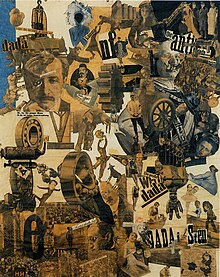
Hannah Höch, Cut with the Kitchen Knife through the Beer-Belly of the Weimar Republic, 1919, collage of pasted papers, 90 x 144 cm, Staatliche Museen, Berlin

Read more... )

Source: https://en.wikipedia.org/wiki/Hannah_H%C3%B6ch

Mathilda (Til) Brugman (16 September 1888, Amsterdam - 24 July 1958, Gouda) was a Dutch author, poet and linguist.

Born in Amsterdam in 1888, Mathilda Maria Petronella Brugman, or Til, was the oldest of nine children in a Roman Catholic family. Her father dealt in wine and spirits and owned vineyards in the South of France and Spain. Brugman’s parents encouraged their daughter’s gift for languages from an early age. Her mother taught her to read, and Til’s father taught her to speak French by the time she was three. Til’s father was Hermanus Johannes Brugman (1852-1931), and her mother was Adriana Geertruida Johanna Zoons (1859-1939). In contrast to her father’s easy going cosmopolitanism, Brugman’s mother was close minded, which Til attributed to her mother’s staunch Catholicism. This alienated the young Brugman and caused her to leave home in anger. In 1911, Til rented a room in Amsterdam and supported herself as a secretary and translator. In 1917, Brugman moved to Den Haag and set up residence with her first lesbian partner, the Dutch concert singer Sienna Mastoff (1892-1959). Brugman lived with Mastoff until she met the German Dada artist Hannah Höch in 1926. Her last partner was Hans Mertineit-Schnabel.

Source: en.wikipedia.org/wiki/Til_Brugman

Days of Love: Celebrating LGBT History One Story at a Time by Elisa Rolle
Paperback: 760 pages
Publisher: CreateSpace Independent Publishing Platform; 1 edition (July 1, 2014)
Language: English
ISBN-10: 1500563323
ISBN-13: 978-1500563325
CreateSpace Store: https://www.createspace.com/4910282
Amazon (Paperback): http://www.amazon.com/dp/1500563323/?tag=elimyrevandra-20
Amazon (Kindle): http://www.amazon.com/dp/B00MZG0VHY/?tag=elimyrevandra-20

Days of Love chronicles more than 700 LGBT couples throughout history, spanning 2000 years from Alexander the Great to the most recent winner of a Lambda Literary Award. Many of the contemporary couples share their stories on how they met and fell in love, as well as photos from when they married or of their families. Included are professional portraits by Robert Giard and Stathis Orphanos, paintings by John Singer Sargent and Giovanni Boldini, and photographs by Frances Benjamin Johnson, Arnold Genthe, and Carl Van Vechten among others. “It's wonderful. Laying it out chronologically is inspired, offering a solid GLBT history. I kept learning things. I love the decision to include couples broken by death. It makes clear how important love is, as well as showing what people have been through. The layout and photos look terrific.” Christopher Bram “I couldn’t resist clicking through every page. I never realized the scope of the book would cover centuries! I know that it will be hugely validating to young, newly-emerging LGBT kids and be reassured that they really can have a secure, respected place in the world as their futures unfold.” Howard Cruse “This international history-and-photo book, featuring 100s of detailed bios of some of the most forward-moving gay persons in history, is sure to be one of those bestsellers that gay folk will enjoy for years to come as reference and research that is filled with facts and fun.” Jack Fritscher
reviews_and_ramblings: (Default)
2015-09-10 02:44 pm

Algernon Islay de Courcy Lyons & Kenneth Macpherson, Bryher & H.D.

Algernon Islay de Courcy Lyons (1922–1993) was a notable Welsh photographer, novelist and linguist.

Born in Langland, Glamorgan, Wales on 7 March 1922, the son of Captain John Algernon de Courcy Lyons, M.C. and Doris Ada Campbell Young. In his lifetime, he was normally just called Islay (pronounced eye-la). (Source unspecified: Lyons was educated at Bradfield College, Berkshire and Grenoble University. He was at Grenoble when World War II broke out. He made a daring escape over the Pyrenees, was caught and imprisoned in Spain from where he manage to escape and work his way back to England where he joined up and served in the Royal Air Force for the rest of the war. He served first in North Africa and then he was sent to the Far East to learn Japanese in 3 months. He did this with amongst others, Richard Mason, who was a lifelong friend and cousin by marriage. Lyons is portrayed by the character 'Peter' in Mason's book 'The Wind Cannot Read'.)

The photographs of Lyons illustrate the works of several twentieth century literary figures, including Bryher and Graham Greene.

Lyons had been the last lover of the film-maker, Kenneth Macpherson, both of them living in the ‘Villa Tuoro’ on Capri. Norman Douglas was their constant companion, there, during the last years of Douglas’s life. Both Macpherson and Lyons were at Norman Douglas’s bedside when he died.

Lyons was a close friend of photographer, Canadian, Roloff Beny.


Kenneth Macpherson, photo by Islay Lyons
Islay Lyons was a notable Welsh photographer, novelist and linguist. During the WWII, he served in North Africa and then he was sent to the Far East to learn Japanese in 3 months. He did this with amongst others, Richard Mason, who was a lifelong friend and cousin by marriage. Lyons is portrayed by the character 'Peter' in Mason's book 'The Wind Cannot Read'.  Lyons had been the last lover of the film-maker, Kenneth Macpherson, both of them living in the ‘Villa Tuoro’ on Capri.


Smiling man in bed

Read more... )

Source: http://en.wikipedia.org/wiki/Algernon_Islay_de_Courcy_Lyons & http://padraigrooney.com/blog/?p=330

Bryher (September 2, 1894 – January 28, 1983) was the pen name of the novelist, poet, memoirist, and magazine editor Annie Winifred Ellerman. She was born in September 1894 in Margate. Her father was the shipowner and financier John Ellerman, who at the time of his death in 1933, was the richest Englishman who had ever lived. He lived with her mother Hannah Glover, but did not marry her until 1908. (Picture: Bryher by Carl Van Vechten)

She traveled in Europe as a child, to France, Italy and Egypt. At the age of fourteen she was enrolled in a traditional English boarding school and at around this time her mother and father married. On one of her travels, Ellerman journeyed to the Isles of Scilly off the southwestern coast of Great Britain and acquired her future pseudonym from her favourite island, Bryher.

During the 1920s, Bryher was an unconventional figure in Paris. Among her circle of friends were Ernest Hemingway, James Joyce, Gertrude Stein, Sylvia Beach and Berenice Abbott. Her wealth enabled her to give financial support to struggling writers, including Joyce and Edith Sitwell. She also helped with finance for Sylvia Beach's bookshop Shakespeare and Company and certain publishing ventures, and started a film company Pool Group. She also helped provide funds to purchase a flat in Paris for the destitute Dada artist and writer Baroness Elsa von Freytag-Loringhoven.


H.D. and Bryher

Read more... )

Source: http://en.wikipedia.org/wiki/Bryher

H.D. (born Hilda Doolittle) (September 10, 1886 – September 27, 1961) was an American poet, novelist and memoirist known for her association with the early 20th century avant-garde Imagist group of poets such as Ezra Pound and Richard Aldington. The Imagist model was based on the idioms, rhythms and clarity of common speech, and freedom to choose subject matter as the writer saw fit. H.D.'s later writing developed on this aesthetic to incorporate a more female-centric version of modernism.

H.D. was born in Pennsylvania in 1886, and moved to London in 1911 where her publications earned her a central role within the then emerging Imagism movement. A charismatic figure, she was championed by the modernist poet Ezra Pound, who was instrumental in building and furthering her career. From 1916–17, she acted as the literary editor of the Egoist journal, while her poetry appeared in the English Review and the Transatlantic Review. During the First World War, H.D. suffered the death of her brother and the breakup of her marriage to the poet Richard Aldington, and these events weighed heavily on her later poetry. She had a deep interest in Ancient Greek literature, and her poetry often borrowed from Greek mythology and classical poets. Her work is noted for its incorporation of natural scenes and objects, which are often used to emote a particular feeling or mood. (Picture: H.D. (sitting) and Bryher in her later years, courtesy of Catherine Aldington Guillaume)

She befriended Sigmund Freud during the 1930s, and became his patient in order to understand and express her bisexuality. H.D. married once, and undertook a number of heterosexual and lesbian relationships. She was unapologetic about her sexuality, and thus became an icon for both the gay rights and feminist movements when her poems, plays, letters and essays were rediscovered during the 1970s and 1980s. This period saw a wave of feminist literature on the gendering of Modernism and psychoanalytical misogyny, by a generation of writers who saw her as an early icon of the feminist movement.


Bryher and H.D. (Hilda Doolittle) during the filming of Borderline (1930)
Close to the end of the war, H.D. (Hilda Doolittle 1886-1961) met the wealthy English novelist Bryher (Annie Winifred Ellerman 1894-1983). They lived together until 1946, and although both took numerous other partners, Bryher remained her lover for the rest of H.D.'s life. From 1920, her relationship with Bryher became closer and the pair travelled in Egypt, Greece and the United States before eventually settling in Switzerland. Bryher married H.D.'s new male lover, bisexual Kenneth Macpherson.

Read more... )

Source: http://en.wikipedia.org/wiki/Hilda_Doolittle

Jimmie Daniels, a nightclub singer who participated in the Kool Jazz Festival's ''Evening of the Music of Harold Arlen'' at Carnegie Hall, died on June 29, 1984 in St. Clare's Hospital after suffering a stroke. He was 76 years old and lived in Manhattan.

Mr. Daniels's repertory focused on the songs of the Gershwins, Rodgers and Hart and Cole Porter as well as Harold Arlen. He worked in New York, Paris, London and Monaco.

James Lesley Daniels was born in Laredo, Tex. From 1939 to 1942, before going into military service, he owned and operated the Harlem supper club that bore his name. Later, he was on the bill at such clubs as the Bon Soir and Little Casino. Most recently he performed at Jan Wallman's Restaurant in Greenwich Village. (Picture: Kenneth Macpherson)

Source: http://www.nytimes.com/1984/07/02/obituaries/jimmie-daniels-singer-dies-performed-in-new-york-clubs.html

"A fresh-faced teenager, Jimmie Daniels arrived in Harlem sometime during the mid-1920's. He was lithe, delicate, and had an engaging, infectious smile that he would soon learn to use to his advantage. Singer Alberta Hunter, a lifelong friend, remembered the time well. "This one was just a little one" she said. "Handsome? Oh, was he handsome! He had hair as red as fire, and his folks had money." Dare anyone have said that they thought the young, refined singer with the impeccable style, grace and proper enunciation was just a little snobbish and affectatious, too?


Daniels and Macpherson out on the town in Harlem with their friend, Lloyd Thomas (actress Edna Thomas' husband)
Richmond Barthe said he chose Jimmie Daniels as his subject because of his dazzling smile, but it was actually Kenneth Macpherson's wife, Winifred Ellerman aka Bryher, who commissioned the bust. Kenneth Macpherson was Jimmie Daniels' lover and his was a marriage of convenience. Bryher supported her husband, who in turn supported Jimmie, thus affording him a high-class life in a Greenwich Village apartment for several years.

Read more... )

Source: http://illkeepyouposted.typepad.com/ill_keep_you_posted/2012/02/jimmie-daniels.html
Many of the gay-oriented clubs were located in the area between Fifth and Seventh Avenues, from 130th to 138th Street, where most of Harlem’s best-known clubs were clustered. The Cotton Club, Connie’s Inn, Barron’s, the Lenox, and other clubs that attracted a large (and sometimes exclusively) white trade were in this district, along with the Savoy Ballroom, Small’s Paradise, and other clubs welcoming a largely black or interracial audience. Many of the district’s most notorious speakeasies and clubs lined a strip on 133rd Street between Lenox and Seventh Avenues known as “The Jungle.” Gay entertainers with large gay followings were featured at several of the district’s clubs, including the Hot Cha at 132nd Street and Seventh Avenue, where the well-known entertainer and host Jimmie Daniels sang sophisticated tunes. A handful of clubs catered to lesbians and gay men, including the Hobby Horse, Tillie’s Kitchen, and the Dishpan, and other well-known clubs, including Small’s Paradise, welcomed their presence.
[...]
The organization of the Hamilton Lodge ball codified the differences between the public styles of middle-class and working-class gay men. Middle-class men passing as straight sat in the balcony with other members of Harlem’s social elite looking down on the spectacle of workingmen in drag. Although the newspapers regularly noted the appearance of Caska Bonds, Harold Jackman, Edward G. Perry, Clinton Moore, Eddie Manchester, Jimmie Daniels, and other middle-class gay men at the balls, they simply included them in the lists of other celebrities and society people in attendance, all presumed to be straight.119 Some of the society people they joined to watch the queers must have known of their involvement in the gay life, and undoubtedly some of the reporters and readers of the papers knew as well. But all concerned seem to have agreed not to say anything. --Chauncey, George (1995-05-18). Gay New York: Gender, Urban Culture, and the Making of the Gay Male World, 1890-1940. BASIC. Kindle Edition.
Philip Johnson found his first serious lover in Harlem-an extremely handsome cafe singer named Jimmie Daniels. Johnson met Daniels during one of his excursions uptown with the composer Virgil Thomson. The architect was enchanted by Daniels, whom he later referred to as "the first Mrs. Johnson." There would be three more "Mrs. Johnsons" after him. Daniels was "a most charming man," Johnson recalled six decades later. "I still look back with greatest pleasure. I was the envy of all downtown. It was so chic in those days-it was what one did if one was really up to date. Those were the days when you just automatically went to Harlem. I had an older friend living in a midtown hotel, and he had an open Chrysler. And every evening when it was still light, we'd go up there. We knew that Harlem was the only place there was any freedom. "We went to the house of an English lady who lived with a black actress-lesbians," Johnson continued. "And in that house Jimmie also lived as a boarder. So it was comfortable and familial. There was also a husband around. I'd spend the night there. I tried to have him downtown; it didn't work so well. They'd say, `I'm sorry we're full tonight'-a totally empty dining room. Even in New York City in the 1930s. "He was a beautiful, beautiful kid," Johnson recalled. "I was always interested in younger people." Daniels was eighteen and Johnson was twenty-five. The affair ended after a year: "A terrible man stole him away-who had better sex with him, I gather. But I was naughty. I went to Europe and I would never think of taking Jimmie along. I had rather an upper-lower-class feeling about him. I didn't realize it at the time, but it must have galled him. Everything that I was doing that was interesting, he wouldn't be included. Terrible way to treat anybody." Virgil Thomson was so impressed by Jimmie Daniels's "impeccable enunciation" that he decided to write an opera "sung by Negroes." The result was Four Saints in Three Acts, with a libretto by Gertrude Stein. Daniels had sung in clubs throughout Europe during the thirties, and he became a fixture of New York nightlife. In 1939, he opened Jimmie Daniels' at 114 West 116th Street, an establishment that The New Yorker described as a "model of dignity and respectability" by "Harlem standards." Ten years later Daniels was the host at the Bon Soir on West 8th Street, where "blacks and whites [and] gays and straights mingled without a trace of tension," according to the historian James Gavin. Barbra Streisand, Phyllis Diller, and Kaye Ballard all eventually performed there.--Charles Kaiser. The Gay Metropolis: The Landmark History of Gay Life in America (Kindle Locations 663-678). Kindle Edition.
Kenneth Macpherson was born in Scotland, 27 March 1902, the son of Scottish painter, John 'Pop' Macpherson and Clara Macpherson. Descended from 6 generations of artists, Macpherson was a novelist, photographer, critic and film-maker. It is only in recent years that Macpherson's contribution to cinematography has come to be recognised with the re-discovery of his work, which, though limited in output, was far ahead of its time, both in subject matter and cinematic technique. His 1930 film, Borderline, is now vey much part of the curriculum in the study of modern cinematography today. In his work with the Pool Group (1927–1933), which he co-founded with Bryher and HD, Macpherson also established the influential film journal, Close Up.

Little is known of Macpherson's early life, the pre-Pool Group period, although much is made of his post-Pool Group years, which appear to have been colourful. One commentator goes as far as to disingenuously identify, for interested parties, the source of 'a lurid description of his personal life during his New York years'. Macpherson's story began in 1927, when he married English writer, Annie Winifred Ellerman, (known as Bryher in the literary world), the daughter of a British shipping magnate. Bryher's inherited fortune would help to finance Macpherson's projects. Although Bryher's and Macpherson's marriage lasted for twenty years, for much of the marriage, both Macpherson and Bryher had extra-marital affairs. Bryher was lesbian but Macpherson was distinctly bi-sexual.

A sexual partner, common to both Bryher and Macpherson, was the American poet, Hilda Doolittle (known in literary circles as "HD"). Doolittle had been a close friend of Bryher's since 1921. They had a lesbian relationship, spending a lot of time together in Riant Chateau, Territet, Switzerland, where Bryher had a house. Not long after their marriage, Macpherson and Bryher moved to Territet, later joined by Doolittle, who brought along her 9 year old daughter, Perdita. (Perdita's father was Cecil Gray, the Scottish music critic and composer). In 1928, Doolittle had a sexual relationship with Macpherson, becoming pregnant by him. The pregnancy would be aborted later that year. In the same year, Macpherson and Bryher formally adopted Perdita, registering her name as Frances Perdita Macpherson.


Kenneth Macpherson and H.D. (Hilda Doolittle) nursing tiger cubs, Territet, Switzerland, 1928
Bryher was the pen name of the novelist, poet, memoirist, and magazine editor Annie Winifred Ellerman. In 1927 she married Kenneth Macpherson, a writer who shared her interest in film and who was at the same time H.D.'s lover (H.D. was Bryher’s lover as well). In Burier, Switzerland, overlooking Lake Geneva, the couple built a Bauhaus-style style structure that doubled as a home and film studio, which they named Kenwin. They formally adopted H.D.'s young daughter, Perdita.


Read more... )

Source: http://en.wikipedia.org/wiki/Kenneth_Macpherson

George Norman Douglas (8 December 1868 – 7 February 1952) was a British writer, now best known for his 1917 novel South Wind. (P: Norman Douglas in 1935)

Norman Douglas was born in Thüringen, Austria (his surname was registered at birth as Douglass). His mother was Vanda von Poellnitz. His father was John Sholto Douglas (1845–1874), manager of a cotton mill, who died in a climbing accident when Douglas was about six. He spent the first years of his life on the family estate, Villa Falkenhorst, in Thüringen.

Douglas was brought up mainly in Scotland at Tilquhillie, Deeside, his paternal home. He was educated at Yarlet Hall and Uppingham School in England, and then at a grammar school in Karlsruhe. Douglas's paternal grandfather was the 14th Laird of Tilquhillie. Douglas's maternal great-grandfather was General James Ochoncar Forbes, 17th Lord Forbes.

He started in the diplomatic service in 1894 and from then until 1896 was based in St. Petersburg, but was placed on leave following a sexual scandal. In 1897 he bought a villa (Villa Maya) in Posillipo, a maritime suburb of Naples. The next year he married a cousin Elizabeth Louisa Theobaldina FitzGibbon (their mothers were sisters, daughters of Baron Ernst von Poellnitz). They had two children, Louis Archibald (Archie) and Robert Sholto (Robin), but divorced in 1903 on grounds of Elizabeth's infidelity. Norman's first book publication, (Unprofessional Tales (1901)) was written under the pseudonym Normyx, in collaboration with Elizabeth.


Norman Douglas, the old roué, photo by Islay Lyons
George Norman Douglas was a British writer, now best known for his 1917 novel South Wind.  Kenneth Macpherson bought a home on Capri, "Villa Tuoro", which he shared with his lover, the photographer, Algernon Islay de Courcy Lyons. Bryher, Macpherson’s wife, supported her husband and his friend on Capri, requesting that they take into their home the aging Douglas. Douglas had been friends of Bryher and Macpherson since 1931. Macpherson remained on Capri until Douglas's death in 1952.


Read more... )

Source: http://en.wikipedia.org/wiki/Norman_Douglas

Days of Love: Celebrating LGBT History One Story at a Time by Elisa Rolle
Paperback: 760 pages
Publisher: CreateSpace Independent Publishing Platform; 1 edition (July 1, 2014)
Language: English
ISBN-10: 1500563323
ISBN-13: 978-1500563325
CreateSpace Store: https://www.createspace.com/4910282
Amazon (Paperback): http://www.amazon.com/dp/1500563323/?tag=elimyrevandra-20
Amazon (Kindle): http://www.amazon.com/dp/B00MZG0VHY/?tag=elimyrevandra-20

Days of Love chronicles more than 700 LGBT couples throughout history, spanning 2000 years from Alexander the Great to the most recent winner of a Lambda Literary Award. Many of the contemporary couples share their stories on how they met and fell in love, as well as photos from when they married or of their families. Included are professional portraits by Robert Giard and Stathis Orphanos, paintings by John Singer Sargent and Giovanni Boldini, and photographs by Frances Benjamin Johnson, Arnold Genthe, and Carl Van Vechten among others. “It's wonderful. Laying it out chronologically is inspired, offering a solid GLBT history. I kept learning things. I love the decision to include couples broken by death. It makes clear how important love is, as well as showing what people have been through. The layout and photos look terrific.” Christopher Bram “I couldn’t resist clicking through every page. I never realized the scope of the book would cover centuries! I know that it will be hugely validating to young, newly-emerging LGBT kids and be reassured that they really can have a secure, respected place in the world as their futures unfold.” Howard Cruse “This international history-and-photo book, featuring 100s of detailed bios of some of the most forward-moving gay persons in history, is sure to be one of those bestsellers that gay folk will enjoy for years to come as reference and research that is filled with facts and fun.” Jack Fritscher
reviews_and_ramblings: (Default)
2015-09-08 07:27 pm

Charlotte Saunders Cushman & Emma Stebbins, Adelaide Anne Procter & Matilda Hays

Adelaide Anne Procter (30 October 1825 – 2 February 1864) was an English poet and philanthropist. She worked prominently on behalf of unemployed women and the homeless, and was actively involved with feminist groups and journals. Procter never married, and some of her poetry has prompted speculation that she was a lesbian. She suffered from ill health, possibly due to her charity work, and died of tuberculosis at the age of 38.

Procter's literary career began when she was a teenager; her poems were primarily published in Charles Dickens's periodicals Household Words and All the Year Round and later published in book form. Her charity work and her conversion to Roman Catholicism appear to have strongly influenced her poetry, which deals most commonly with such subjects as homelessness, poverty, and fallen women.

Procter was the favourite poet of Queen Victoria. Her poetry went through numerous editions in the 19th century; Coventry Patmore called her the most popular poet of the day, after Alfred, Lord Tennyson. Her poems were set to music and made into hymns, and were published in the United States and Germany as well as in England. Nonetheless, by the early 20th century her reputation had diminished, and few modern critics have given her work attention. Those who have, however, argue that Procter's work is significant, in part for what it reveals about how Victorian women expressed otherwise repressed feelings.

Read more... )

Source: https://en.wikipedia.org/wiki/Adelaide_Anne_Procter

Charlotte Saunders Cushman (July 23, 1816 – February 18, 1876) was an American stage actress. (P: ©Thomas Sully (1783- 1872)/ Library Company of Philadelphia. Bequest of Anne Hampton Brewster, 1892. Charlotte Saunders Cushman, “of the Walnut Street Theater,” 1843 (©4))

She was a descendant in the eighth generation from Pilgrim Robert Cushman. Robert Cushman brought the family name to the United States on the Mayflower as a leader and great advocate for emigration to America. He became a preacher in the colonies, and was known to have given the first sermon in America. Her father, Elkanah, rose from poverty to be a successful West Indian merchant, but lost his fortune, and died, leaving his family in straitened circumstances. Charlotte was a remarkably bright, sportive child, excelling her schoolmates and developing a voice of remarkable compass and richness, with a full contralto register. Two friends of her father, one of them John Mackay (Mackey?), in whose piano factory Jonas Chickering was then foreman, provided her with the best musical instruction. Cushman was forced to take on serious responsibilities at a very young age. At the age of thirteen, her father underwent serious financial troubles and shortly after died, leaving his family with nearly nothing. This caused Charlotte to find her way to bring income to her family. Though Cushman was an incredibly great student and achieved much academically, she left school to pursue a career in the opera.

When Mrs. Joseph Wood visited Boston in 1834, Capt. Mackay introduced Cushman, who sang with her in two of her concerts. Through Mrs. Wood's influence she became a pupil of James G. Maeder, a lady's musical director, and under his instruction made her first appearance in opera in the Tremont Theatre as the Countess Almaviva in The Marriage of Figaro with great success, and her second as Lucy Bertram in Guy Mannering. She went with his company to New Orleans, where her voice, which had been strained by the soprano parts assigned to her, suddenly failed. Seeking the counsel of James H. Caldwell, manager of the principal theatre of New Orleans, she was advised by him and by Barton, the tragedian, to become an actress, and given the part of Lady Macbeth to study, in which she made her appearance with complete success in 1835.


Charlotte Saunders Cushman and Miss Matilda Hays, Artist: Josiah Johnson Hawes (American, Wayland, Massachusetts 1808–1901 Crawford Notch, New Hampshire) Date: ca. 1850 Medium: Daguerreotype Dimensions:21.6 x 16.5 cm (8 1/2 x 6 1/2 in.) Credit Line: Gift of I. N. Phelps Stokes, Edward S. Hawes, Alice Mary Hawes, and Marion Augusta Hawes, 1937 (Holman's Print Shop, Boston), Metropolitan Museum of Art
Charlotte Saunders Cushman was an American stage actress. In 1848, Cushman met journalist, writer and part-time actress Matilda Hays. In 1854, Hays left Cushman for lesbian sculptor Harriet Hosmer. Hays eventually returned to live with Cushman, but by late 1857, Cushman was secretly involved with sculptor Emma Stebbins. Stebbins best-known work is the Angel of the Waters (1873), also known as Bethesda Fountain, located on the Bethesda Terrace in Central Park, New York.

Read more... )

Source: http://en.wikipedia.org/wiki/Charlotte_Saunders_Cushman

Emma Stebbins (1 September 1815 — 25 October 1882) was among the first notable American woman sculptors. (Picture: Emma Stebbins (1815 - 1882 ), US Sculptor and lesbian pioneer; Stebbins best known work is the Angel of the Waters (1873), also known as Bethesda Fountain, located on the Bethesda Terrace in Central Park, New York)

Stebbins was born and died in New York City. Raised in a wealthy New York family, she was encouraged by her family in her pursuit of art from an early age. In 1857, sponsored by her brother Col. Henry G. Stebbins, head of the New York Stock Exchange, she moved to Rome where she moved in with sculptor Harriet Hosmer, who had established herself there in 1852. She studied under John Gibson an English neoclassicist working there at that time. In Rome she fell in love with actress Charlotte Saunders Cushman, and quickly became involved in the bohemian and feminist lesbian lifestyle, which was more tolerated there than it would have been back in New York.

Cushman was confident, strong, and charismatic, and recently recovering from a break up following a ten-year relationship with the actress Matilda Hays. Cushman and Stebbins began traveling together, immediately taking a trip to Naples. Upon their return, they began spending time in a circle that included African American/Native American sculptor Edmonia Lewis, many celebrities, and fellow lesbians that included Harriet Hosmer. In this environment, the women flourished without regard for showing outward affection for one another.


Bethesda Fountain by Elisa Rolle, October 2012
Emma Stebbins was among the first notable American woman sculptors. Stebbins best known work is the Bethesda Fountain, located on the Bethesda Terrace in Central Park, New York. In 1857 she moved to Rome and fell in love with actress Charlotte Saunders Cushman. In 1869, Cushman was treated for breast cancer. Stebbins devoted all her time during that ordeal to nursing her lover, ignoring her work during the next two years. Cushman died of pneumonia in 1876. Stebbins died in New York in 1882.

Read more... )

Source: http://en.wikipedia.org/wiki/Emma_Stebbins

Matilda Mary Hays (8 September 1820 – 3 July 1897) was a 19th-century English writer, journalist and part-time actress. With Elizabeth Ashurt, Hays translated several of George Sand's works into English. She co-founded the English Woman's Journal. Her love interests included the actress Charlotte Saunders Cushman, with whom she had a 10-year relationship, and the poet Adelaide Anne Procter.

Matilda Hays was born in St Pancras London on 8 September 1820, the daughter of corn merchant John Hays (1768–1862) and his wife Elizabeth. Hays came from a long line of Thames lightermen. Hays was identified as a Creole or half Creole; if this is so, at most she can only have been half Creole through her mother; her father's origins are Londoners going back at least three generations. She wrote articles for periodicals, often regarding women's issues, starting about 1838. The periodicals included The Mirror and Ainsworth's Magazine. (P: Adelaide Anne Procter, Undated portrait by Emma Gaggiotti Richards)

Hays, influenced by George Sand, was a journalist and novelist who was "determined to use her writing to improve the condition of women." In her novel Helen Stanley, Hays wrote that until "Women teach their daughters to respect themselves,... to work for their daily bread, rather than prostitute their persons and hearts" in marriages, women would not have secure financial and social futures. 

At a period in time when George Sand's free-love and independent lifestyle was quite unusual for a 19th-century woman, Hays and her friend, Elizabeth Ashurst were "broad-minded" and intrigued by the political and social messages addressed in Sand's books. Hays had received support and encouragement from William Charles Macready and George Henry Lewes to translate Sand's novels into English. Both wrote to Sands encouraging the arrangement and a friend of Hays, chaplain Edmund Larken provided funding for the enterprise.

Read more... )

Source: en.wikipedia.org/wiki/Matilda_Hays

Days of Love: Celebrating LGBT History One Story at a Time by Elisa Rolle
Paperback: 760 pages
Publisher: CreateSpace Independent Publishing Platform; 1 edition (July 1, 2014)
Language: English
ISBN-10: 1500563323
ISBN-13: 978-1500563325
CreateSpace Store: https://www.createspace.com/4910282
Amazon (Paperback): http://www.amazon.com/dp/1500563323/?tag=elimyrevandra-20
Amazon (Kindle): http://www.amazon.com/dp/B00MZG0VHY/?tag=elimyrevandra-20

Days of Love chronicles more than 700 LGBT couples throughout history, spanning 2000 years from Alexander the Great to the most recent winner of a Lambda Literary Award. Many of the contemporary couples share their stories on how they met and fell in love, as well as photos from when they married or of their families. Included are professional portraits by Robert Giard and Stathis Orphanos, paintings by John Singer Sargent and Giovanni Boldini, and photographs by Frances Benjamin Johnson, Arnold Genthe, and Carl Van Vechten among others. “It's wonderful. Laying it out chronologically is inspired, offering a solid GLBT history. I kept learning things. I love the decision to include couples broken by death. It makes clear how important love is, as well as showing what people have been through. The layout and photos look terrific.” Christopher Bram “I couldn’t resist clicking through every page. I never realized the scope of the book would cover centuries! I know that it will be hugely validating to young, newly-emerging LGBT kids and be reassured that they really can have a secure, respected place in the world as their futures unfold.” Howard Cruse “This international history-and-photo book, featuring 100s of detailed bios of some of the most forward-moving gay persons in history, is sure to be one of those bestsellers that gay folk will enjoy for years to come as reference and research that is filled with facts and fun.” Jack Fritscher
reviews_and_ramblings: (Default)
2015-09-06 10:19 am

Violet Oakley, Elizabeth Shippen Green, Jessie Willcox Smith & Henrietta Cozens

Elizabeth Shippen Green (September 1, 1871 – 1954) was an American illustrator. She illustrated children's books and worked for many years for Harper's Magazine.

Green studied with the painters Thomas Anshutz and Robert Vonnoh at the Pennsylvania Academy of Fine Arts (1889–1893). She then began study with Howard Pyle at Drexel Institute where she met Violet Oakley and Jessie Willcox Smith.

As educational opportunities were made more available in the 19th-century, women artists became part of professional enterprises, including founding their own art associations. Artwork made by women was considered to be inferior, and to help overcome that stereotype women became “increasingly vocal and confident” in promoting women's work, and thus became part of the emerging image of the educated, modern and freer “New Woman”. Artists "played crucial roles in representing the New Woman, both by drawing images of the icon and exemplifying this emerging type through their own lives.” In the late 19th-century and early 20th century about 88% of the subscribers of 11,000 magazines and periodicals were women. As women entered the artist community, publishers hired women to create illustrations that depict the world through a woman's perspective. Other successful illustrators were Jennie Augusta Brownscombe, Jessie Wilcox Smith, Rose O'Neill, and Violet Oakley.

Green was a member of Philadelphia's The Plastic Club, an organization established to promote "Art for art's sake". Other members included Elenore Abbott, Jessie Willcox Smith, and Violet Oakley. Many of the women who founded the organization had been students of Howard Pyle. It was founded to provide a means to encourage one another professionally and create opportunities to sell their works of art.


"The Journey": illustration for a series of poems by Josephine Preston Peabody, entitled "The Little Past", which relate experiences of childhood from a child's perspective. Published in Harper's Magazine, December 1903. Restored digital file from original oil painting.

Read more... )

Source: en.wikipedia.org/wiki/Elizabeth_Shippen_Green

Jessie Willcox Smith (September 6, 1863 – May 3, 1935) was one of the most prominent female illustrators in the United States during the Golden Age of American illustration. She was a prolific contributor to respected books and magazines during the late 19th and early 20th centuries. She illustrated stories and articles for clients such as Century, Collier's, Leslie's Weekly, Harper's, McClure's, Scribners, and the Ladies' Home Journal. She had an ongoing relationship with Good Housekeeping, including the long-running Mother Goose series of illustrations and creating all the covers from 1915 to 1933. Among the more than 60 books that Smith illustrated were Louisa May Alcott's Little Women and An Old-Fashioned Girl, Henry Wadsworth Longfellow's Evangeline, and Robert Louis Stevenson's A Child's Garden of Verses.

Jessie Willcox Smith was born in the Mount Airy neighborhood of Philadelphia, Pennsylvania. She was the youngest girl born to Charles Henry Smith, an investment broker, and Katherine DeWitt Willcox Smith. Jessie attended private elementary schools and at the age of sixteen she was sent to Cincinnati, Ohio to live with her cousins and finish her education. She trained to be a teacher and taught kindergarten in 1883, but found that the physical demands of working with children too strenuous for her; Due to back problems, she had difficulty bending down to their level. Persuaded to attend one of her friend or cousin's art classes, Smith realized she had a talent for drawing.

In 1884 or 1885, Smith attended the Philadelphia School of Design for Women (now Moore College of Art and Design) and in 1885 attended the Pennsylvania Academy of the Fine Arts (PAFA) in Philadelphia under Thomas Eakins and Thomas Anshute's supervision. It was under Eakins that Smith began to use photography as a resource in her illustrations. Although Eakins' demeanor could be difficult, particularly with female students, he became one of her first major influences. In May 1888, while Smith was still at the Pennsylvania Academy, her illustration Three Little Maidens All in a Row was published in the St. Nicholas Magazine. Illustration was a professional avenue that women could employ to make a living as an artist at the time. At this time, creating illustrations for children's books or of family life was considered an appropriate career for woman artists because it drew upon maternal instincts. Fine art that included life drawing was not considered lady-like. Illustration became a viable career partly due to improved color printing processes and the resurgence in England in book design. Smith graduated from PAFA in June 1888 and joined the first magazine for women, the Ladies' Home Journal the same year, where she had an entry-level position in the advertising department finishing rough sketches, designing borders, and preparing advertising art for the magazine. She illustrated the book of poetry New and True (1892) by Mary Wiley Staver.


Photograph of Violet Oakley and Jessie Willcox Smith facing the camera and Elizabeth Shippen Green and Henrietta Cozens , who are partially hidden, c. 1901, Violet Oakley papers, Archives of American Art, Smithsonian Institution.
Illustrators Jessie Wilcox Smith and Elizabeth Shippen Green, and Muralist Violet Oakley, took over the Red Rose Inn, a picturesque estate in Villanova, on Philadelphia's Main Line. They made a pact to live together forever - until one of them created havoc by marrying (Elizabeth Shippen Green in 1911). The three illustrators received the "Red Rose Girls" nickname. They later lived, along with Henrietta Cozens, in a home in the Mt. Airy neighborhood of Philadelphia that they named Cogslea after their four surnames (Cozens, Oakley, Green and Smith).

Read more... )

Source: en.wikipedia.org/wiki/Jessie_Willcox_Smith

Green-Wood Cemetery was founded in 1838 as a rural cemetery in Kings County, New York. It was granted National Historic Landmark status in 2006 by the U.S. Department of the Interior.

There is buried Violet Oakley (June 10, 1874 – February 25, 1961), who, in 1902, received the largest public mural commission for an American woman until that time, at the Pennsylvania state capitol in Harrisburg. She lived in a “Boston marriage” with three other female artists (nicknamed the Red Rose Girls).

Oakley and her two friends, the artists Elizabeth Shippen Green and Jessie Willcox Smith, all former students of Pyle, were named the Red Rose girls by him. The three illustrators received the "Red Rose Girls" nickname while they lived together in the Red Rose Inn in Villanova, Pennsylvania from 1899 to 1901. They later lived, along with Henrietta Cozens (1862 - 1940), in a home in the Mt. Airy neighborhood of Philadelphia that they named Cogslea after their four surnames (Cozens, Oakley, Green and Smith).

Violet Oakley was the first American woman to receive a public mural commission. During the first quarter of the twentieth century, she was renowned as a pathbreaker in mural decoration, a field that had been exclusively practiced by men. Oakley excelled at murals and stained glass designs that addressed themes from history and literature in Renaissance-revival styles.

Oakley was born in Bergen Heights (a section of Jersey City), New Jersey, into a family of artists. Her parents were Arthur Edmund Oakley and Cornelia Swain. Both of her grandfathers were member of the National Academy of Design. In 1892, she studied at the Art Students League of New York. A year later, she studied in England and France, under Raphaël Collin and others. After her return to the United States in 1896, she studied briefly at the Pennsylvania Academy of the Fine Arts before she joined Howard Pyle's famous illustration class at Drexel Institute. She had early success as a popular illustrator for magazines including The Century Magazine, Collier's Weekly, St. Nicholas Magazine, and Woman's Home Companion. The style of her illustrations and stained glass reflects her emulation of the English Pre-Raphaelites. Oakley's commitment to Victorian aesthetics during the advent of Modernism led to the decline of her reputation by the middle of the twentieth century.


Violet Oakley Studio on the NRHP since September 13, 1977. At 627 St. George's Road in Mount Airy neighborhood of NW Philadelphia. Pennsylvania Historical and Museum Commission marker is in front of this house, 621. The next house on the street is 631. There is a private drive between the 2, so the actual studio may be behind this building (if the apparent contradiction of the sources is forced to be resolved)

Read more... )

Source: en.wikipedia.org/wiki/Violet_Oakley

Further Readings )

More Real Life Romances at my website: www.elisarolle.com
reviews_and_ramblings: (Default)
2015-09-02 12:17 pm

Charlie Saputo & Mel Odom

Mel Odom (born September 2, 1950) is an American artist who has created book covers for numerous novels, notably several books by fantasy author Guy Gavriel Kay such as The Fionavar Tapestry trilogy, Tigana, A Song for Arbonne, and The Lions of Al-Rassan. Odom was also the designer of the Gene Marshall collectible fashion doll. He celebrated his 19 years together with his partner Charlie Saputo, whom he married in New York City in July 2013.

Odom was born in Richmond Virginia and grew up in Ahoskie, North Carolina, where his parents nurtured his interests in drawing and in dolls. He majored in fashion illustration at Virginia Commonwealth University and pursued some graduate studies in England before moving to New York City in 1975.

His distinctively elegant Art Deco-like style quickly established him as a successful commercial artist, at first via erotic illustrations for sexually-oriented magazines such as Blueboy, Viva, and Playboy, the last of which named him their "Illustrator of the Year" in 1980. In the same year, he provided the cover art for Edmund White's novel Nocturnes for the King of Naples, which opened his path to a wider audience.

During the 1980s, his work achieved success in many commercial media. He created album covers for CBS Records and book covers for numerous other novels, usually in the genres of fantasy, mystery, or horror. He provided illustrations for the science/science-fiction magazine OMNI and (in 1989) a front cover for Time magazine. He also received professional recognition from his peers, receiving the Society of Illustrators's Gold Medal (Editorial category) in 1982 and a Silver Medal (Book category) in 1987. He has exhibited his work in New York City at the Cooper-Hewitt Museum and the Society of Illustrators.


Mel Odom is an American artist who has created covers for numerous novels, notably for fantasy author Guy Gavriel Kay such as The Fionavar Tapestry trilogy, Tigana, A Song for Arbonne, and The Lions of Al-Rassan. Odom was also the designer of the Gene Marshall fashion doll. He celebrated his 19 years together with his partner Charlie Saputo, whom he married in New York City on July 3, 2013. "In Mel Odom's world the perverse has become at last a candid pleasure...a vision of utopia" Edmund White


Mouth to Mouth or Arrangement, 1979, Blueboy Magazine

Read more... )

Source: http://en.wikipedia.org/wiki/Mel_Odom_(artist)

more illustrations )

more covers )

Gene Marshall )

Days of Love: Celebrating LGBT History One Story at a Time by Elisa Rolle
Paperback: 760 pages
Publisher: CreateSpace Independent Publishing Platform; 1 edition (July 1, 2014)
Language: English
ISBN-10: 1500563323
ISBN-13: 978-1500563325
CreateSpace Store: https://www.createspace.com/4910282
Amazon (Paperback): http://www.amazon.com/dp/1500563323/?tag=elimyrevandra-20
Amazon (Kindle): http://www.amazon.com/dp/B00MZG0VHY/?tag=elimyrevandra-20

Days of Love chronicles more than 700 LGBT couples throughout history, spanning 2000 years from Alexander the Great to the most recent winner of a Lambda Literary Award. Many of the contemporary couples share their stories on how they met and fell in love, as well as photos from when they married or of their families. Included are professional portraits by Robert Giard and Stathis Orphanos, paintings by John Singer Sargent and Giovanni Boldini, and photographs by Frances Benjamin Johnson, Arnold Genthe, and Carl Van Vechten among others. “It's wonderful. Laying it out chronologically is inspired, offering a solid GLBT history. I kept learning things. I love the decision to include couples broken by death. It makes clear how important love is, as well as showing what people have been through. The layout and photos look terrific.” Christopher Bram “I couldn’t resist clicking through every page. I never realized the scope of the book would cover centuries! I know that it will be hugely validating to young, newly-emerging LGBT kids and be reassured that they really can have a secure, respected place in the world as their futures unfold.” Howard Cruse “This international history-and-photo book, featuring 100s of detailed bios of some of the most forward-moving gay persons in history, is sure to be one of those bestsellers that gay folk will enjoy for years to come as reference and research that is filled with facts and fun.” Jack Fritscher
reviews_and_ramblings: (Default)
2015-09-02 12:14 pm

Abby Adeline Manning & Anne Whitney

Anne Whitney (September 2, 1821 – January 23, 1915) was an American sculptor and poet. She was born in Watertown, Massachusetts and died Boston, Massachusetts. Other than notable public figures, she also sculpted members of her family and the painter Abby Adeline Manning (1836-1906), with whom Whitney is said to have had a "Boston marriage." Manning's work has since fallen into obscurity, and she is remembered now primarily as Whitney's longtime companion. (P: Sonrel. Portrait of Anne Whitney, Smithsonian / Regional Reports. Archives of American Art Journal, Vol. 42, No. 1/2 (2002))

Hailing from a wealthy, liberal Unitarian Boston family, sculptor Anne Whitney was politically active in support of abolition and women's equality. Her choice of subjects--abolitionists, feminists, and blacks--reflected her political and social beliefs.

As a woman artist in a male-dominated field, Whitney experienced her own struggles for equality: in 1875, having been a sculptor for nearly twenty years, she entered a national competition for a sculpture of the abolitionist Charles Sumner. Whitney won the commission, only to be denied the job when it was realized that she was a woman.

It was "publicly decreed that a woman could not accurately sculpt a man's legs." Outraged all the more because the abolitionist subject was dear to her heart, and determined that such discrimination would not happen to her again, she never entered another competition. She did, however, decide to produce the statue anyway. It now stands outside Harvard Law School.


©Anne Whitney (1821-1915)/Davis Museum and Cultural Center, Wellesley College. Abby Adeline Manning, 1861 (©4)
Anne Whitney was an American sculptor and poet. Whitney sculpted notable people but also the painter Abby Adeline Manning, with whom Whitney is said to have had a "Boston marriage." Manning's work has since fallen into obscurity, and she is remembered now primarily as Whitney's longtime companion.  Manning and Whitney perhaps met around 1862 when Anne was studying with the renowned William Rimmer. By 1878 Adeline and Anne were living and working in their new studio at 92 Mt. Vernon in Boston.


Abby Adeline Manning (June 1836 - May 21, 1906) & Anne Whitney (September 2, 1821 – January 23, 1915)'s ashes are buried under the same headstone in Mount Auburn Cemetery, Cambridge, Massachusetts.


Read more... )

Citation Information
Author: Williams, Carla
Entry Title: Whitney, Anne
General Editor: Claude J. Summers
Publication Name: glbtq: An Encyclopedia of Gay, Lesbian, Bisexual, Transgender, and Queer Culture
Publication Date: 2002
Date Last Updated May 12, 2008
Web Address www.glbtq.com/arts/whitney_a.html
Publisher glbtq, Inc.
1130 West Adams
Chicago, IL 60607
Today's Date January 23, 2014
Encyclopedia Copyright: © 2002-2006, glbtq, Inc.
Entry Copyright © 2002, glbtq, Inc.

Further Readings:

Days of Love: Celebrating LGBT History One Story at a Time by Elisa Rolle
Paperback: 760 pages
Publisher: CreateSpace Independent Publishing Platform; 1 edition (July 1, 2014)
Language: English
ISBN-10: 1500563323
ISBN-13: 978-1500563325
CreateSpace Store: https://www.createspace.com/4910282
Amazon (Paperback): http://www.amazon.com/dp/1500563323/?tag=elimyrevandra-20
Amazon (Kindle): http://www.amazon.com/dp/B00MZG0VHY/?tag=elimyrevandra-20

Days of Love chronicles more than 700 LGBT couples throughout history, spanning 2000 years from Alexander the Great to the most recent winner of a Lambda Literary Award. Many of the contemporary couples share their stories on how they met and fell in love, as well as photos from when they married or of their families. Included are professional portraits by Robert Giard and Stathis Orphanos, paintings by John Singer Sargent and Giovanni Boldini, and photographs by Frances Benjamin Johnson, Arnold Genthe, and Carl Van Vechten among others. “It's wonderful. Laying it out chronologically is inspired, offering a solid GLBT history. I kept learning things. I love the decision to include couples broken by death. It makes clear how important love is, as well as showing what people have been through. The layout and photos look terrific.” Christopher Bram “I couldn’t resist clicking through every page. I never realized the scope of the book would cover centuries! I know that it will be hugely validating to young, newly-emerging LGBT kids and be reassured that they really can have a secure, respected place in the world as their futures unfold.” Howard Cruse “This international history-and-photo book, featuring 100s of detailed bios of some of the most forward-moving gay persons in history, is sure to be one of those bestsellers that gay folk will enjoy for years to come as reference and research that is filled with facts and fun.” Jack Fritscher

reviews_and_ramblings: (Default)
2015-09-01 02:32 pm

Baron Adolph de Meyer, Olga de Meyer & Ernest Frohlich

Baron Adolph de Meyer (1 September 1868 – 6 January 1946) was a photographer famed for his elegant photographic portraits in the early 20th century, many of which depicted celebrities such as Mary Pickford, Rita Lydig, Luisa Casati, Billie Burke, Irene Castle, John Barrymore, Lillian Gish, Ruth St. Denis, King George V of the United Kingdom, and Queen Mary. He was also the first official fashion photographer for the American magazine Vogue, appointed to that position in 1913.

Reportedly born in Paris and educated in Dresden, Adolphus Meyer was the son of a German Jewish father and Scottish mother—Adolphus Louis Meyer and his wife, the former Adele Watson.

In 1893 he joined the Royal Photographic Society and moved to London in 1895. (Drawing of Olga de Meyer by John Singer Sargent, 1907)

He used the surnames Meyer, von Meyer, de Meyer, de Meyer-Watson, and Meyer-Watson at various times in his life. From 1897 he was known as Baron Adolph Edward Sigismond de Meyer, though some contemporary sources list him as Baron Adolph von Meyer and Baron Adolph de Meyer-Watson.

In editions dating from 1898 until 1913, Whitaker's Peerage stated that de Meyer's title had been granted in 1897 by Frederick Augustus III of Saxony, though another source states "the photographer inherited it from his grandfather in the 1890s". Some sources state that no evidence of this nobiliary creation, however, has been found.


Olga de Meyer was an artists' model, socialite, patron of the arts, writer, and fashion figure of the early 20th century. She was best known as the wife of photographer Adolph de Meyer and was rumored to be the natural daughter of King Edward VII. Violet Trefusis said of the de Meyers—who counted Olga among her lovers and whose mother, Alice Keppel, was Edward VII's mistress—as "Pederaste and Médisante" because, as Trefusis observed, "He looked so queer and she had such a vicious tongue."


Baron Adolph de Meyer was the first official fashion photographer for the American magazine Vogue. After the death of his wife, Baron de Meyer became romantically involved with a young German, Ernest Frohlich, whom he hired as his chauffeur and later adopted as his son. The latter went by the name Baron Ernest Frohlich de Meyer. From 1898 to 1913, de Meyer lived in fashionable Cadogan Gardens, London, and between 1903 and 1907 his work was published in Alfred Stieglitz's quarterly Camera Work.

Read more... )

Source: http://en.wikipedia.org/wiki/Adolph_de_Meyer

Days of Love: Celebrating LGBT History One Story at a Time by Elisa Rolle
Paperback: 760 pages
Publisher: CreateSpace Independent Publishing Platform; 1 edition (July 1, 2014)
Language: English
ISBN-10: 1500563323
ISBN-13: 978-1500563325
CreateSpace Store: https://www.createspace.com/4910282
Amazon (Paperback): http://www.amazon.com/dp/1500563323/?tag=elimyrevandra-20
Amazon (Kindle): http://www.amazon.com/dp/B00MZG0VHY/?tag=elimyrevandra-20

Days of Love chronicles more than 700 LGBT couples throughout history, spanning 2000 years from Alexander the Great to the most recent winner of a Lambda Literary Award. Many of the contemporary couples share their stories on how they met and fell in love, as well as photos from when they married or of their families. Included are professional portraits by Robert Giard and Stathis Orphanos, paintings by John Singer Sargent and Giovanni Boldini, and photographs by Frances Benjamin Johnson, Arnold Genthe, and Carl Van Vechten among others. “It's wonderful. Laying it out chronologically is inspired, offering a solid GLBT history. I kept learning things. I love the decision to include couples broken by death. It makes clear how important love is, as well as showing what people have been through. The layout and photos look terrific.” Christopher Bram “I couldn’t resist clicking through every page. I never realized the scope of the book would cover centuries! I know that it will be hugely validating to young, newly-emerging LGBT kids and be reassured that they really can have a secure, respected place in the world as their futures unfold.” Howard Cruse “This international history-and-photo book, featuring 100s of detailed bios of some of the most forward-moving gay persons in history, is sure to be one of those bestsellers that gay folk will enjoy for years to come as reference and research that is filled with facts and fun.” Jack Fritscher
reviews_and_ramblings: (Default)
2015-08-31 10:42 am

Margarett Sargent & Shawn McKean

Margarett Sargent (August 31, 1892 - 1978) was born in 1892 into the privileged world of old Boston money (she was a distant relative of John Singer Sargent) and a life of rigid convention from which few (especially women) broke free. Art provided her ticket out of this claustral milieu. After breaking an engagement, she began her training in Italy as a sculptor (''If only we hadn't sent her to Europe,'' her family would say whenever she did something un-Bostonian, which was fairly often), and later turned to watercolors and oils. She had her first one-woman show in New York in 1926, quickly followed by others in Chicago and Boston. But just as she was establishing her reputation, she stopped exhibiting, and soon stopped painting altogether.

Margarett, 5 foot 10, raven-haired, ivory-skinned, blue-eyed, becomes a socialite, a student of Mount Rushmore's Gutzon Borglum and painter George Luks, a member of the artistic avant garde of New York and Boston, and, within conventions -- she's a virgin -- a seductress of note. She also may be having an affair with her New York roommate, Marjorie Davenport.

Her personal life was more shocking than her paintings, which reflected an expressionism not much in vogue at the time. She waited until 1920, and the age of 28, to marry another proper Bostonian, Quincy Adams Shaw McKean (November 1, 1891 – August 1971) , a polo-playing, dog-breeding Boston aristocrat and owner of a remarkable estate called Prides, who promises her a career but doesn't know what he's bargained for. They had four children in the next three years. The marriage had its problems (ironically, not conflicts over her career -- her husband accepted her artistic aspirations), and Margarett ''took to affairs,'' an old friend noted, ''as easily as to brushing her teeth.'' These affairs included both men and women, and many took place on Boston's North Shore at Prides, the McKean home, a 17th-century saltbox transformed into a Yankee palazzo so grand it required a staff of 13.


Sargent, Margarett W., Beyond Good and Evil (Self-Portrait), ca. 1930, Gift of Honor Moore, Davis Museum and Cultural Center, Wellesley College
Margarett Sargent was born into the privileged world of old Boston money; a socialite, a student of Mount Rushmore's Gutzon Borglum and painter George Luks, a member of the artistic avant-garde of New York and Boston. She also may be having an affair with her New York roommate, Marjorie Davenport. She married Quincy Adams Shaw McKean, a polo-playing, dog-breeding Boston aristocrat and owner of an estate called Prides. They had four children in the next 3 years.

Read more... )

Source: www.nytimes.com/books/97/07/27/nnp/19414.html

Days of Love: Celebrating LGBT History One Story at a Time by Elisa Rolle
Paperback: 760 pages
Publisher: CreateSpace Independent Publishing Platform; 1 edition (July 1, 2014)
Language: English
ISBN-10: 1500563323
ISBN-13: 978-1500563325
CreateSpace Store: https://www.createspace.com/4910282
Amazon (Paperback): http://www.amazon.com/dp/1500563323/?tag=elimyrevandra-20
Amazon (Kindle): http://www.amazon.com/dp/B00MZG0VHY/?tag=elimyrevandra-20

Days of Love chronicles more than 700 LGBT couples throughout history, spanning 2000 years from Alexander the Great to the most recent winner of a Lambda Literary Award. Many of the contemporary couples share their stories on how they met and fell in love, as well as photos from when they married or of their families. Included are professional portraits by Robert Giard and Stathis Orphanos, paintings by John Singer Sargent and Giovanni Boldini, and photographs by Frances Benjamin Johnson, Arnold Genthe, and Carl Van Vechten among others. “It's wonderful. Laying it out chronologically is inspired, offering a solid GLBT history. I kept learning things. I love the decision to include couples broken by death. It makes clear how important love is, as well as showing what people have been through. The layout and photos look terrific.” Christopher Bram “I couldn’t resist clicking through every page. I never realized the scope of the book would cover centuries! I know that it will be hugely validating to young, newly-emerging LGBT kids and be reassured that they really can have a secure, respected place in the world as their futures unfold.” Howard Cruse “This international history-and-photo book, featuring 100s of detailed bios of some of the most forward-moving gay persons in history, is sure to be one of those bestsellers that gay folk will enjoy for years to come as reference and research that is filled with facts and fun.” Jack Fritscher
reviews_and_ramblings: (Default)
2015-08-30 09:35 am

Leonor Fini, Stanislao Lepri & Konstanty Jeleński

Leonor Fini (August 30, 1907 – January 18, 1996) was an Argentine surrealist painter. Fini only married once, for a brief period,to Fedrico Veneziani. They were divorced after she met the Italian Count, Stanislao Lepri (Roma 1905 - Parigi 1980), who abandoned his diplomatic career shortly after meeting Fini and lived with her thereafter. She met the Polish writer Konstanty Jeleński (January 2, 1922 - May 4, 1987), known as Kot in Paris right after the war. She was delighted to discover that he was the illegitimate half-brother of Sforzino Sforza, who had been one of her most favorite lovers. Kot joined Fini and Lepri in their Paris apartment in 1952 and the three remained inseparable until their deaths. (P: Carl Van Vechten (1880–1964). Argentine surrealist painter Leonor Fini, 1936)

She later employed an assistant to join the household, which he described as "a little bit of prison and a lot of theatre". One of his jobs was to look after her beloved Persian cats. Over the years she acquired 17 of them; they shared her bed and, at mealtimes, were allowed to roam the dining-table selecting tasty morsels - and woe betide the guest who complained. The 'inner circle' expanded to include the American artist, Richard Overstreet and the Argentinian poet Juan-Bautista Pinero. (P: Leonor Fini. Portrait of Stanislao Lepri)

Born in Buenos Aires, Argentina, she was raised in Trieste, Italy. She moved to Milan at the age of 17, and then to Paris, in either 1931 or 1932. There, she became acquainted with, among many others, Paul Éluard, Max Ernst, Georges Bataille, Henri Cartier-Bresson, Picasso, André Pieyre de Mandiargues, and Salvador Dalí. She traveled Europe by car with Mandiargues and Cartier-Bresson where she was photographed nude in a swimming pool by Cartier-Bresson. The photograph of Fini sold in 2007 for $305,000 - the highest price paid at auction for one of his works to that date.


Stanislao Lepri and Leonor Fini, 1945
Leonor Fini was a surrealist painter. She met Count Stanislao Lepri, who abandoned his diplomatic career shortly after meeting Fini and lived with her thereafter. She met the Polish writer Konstanty Jeleński, known as Kot in Paris right after the war. She was delighted to discover that he was the illegitimate half-brother of Sforzino Sforza, who had been one of her most favorite lovers. Kot joined Fini and Lepri in their Paris apartment in 1952 and they remained inseparable until their deaths.


Stanislao Lepri, Les Voyeurs, oil on panel, 1949. Provenance: Leonor Fini, Paris


Leonor Fini, La Leçon de Botanique (The Botany Lesson), oil on canvas, 1974

Read more... )

Source: en.wikipedia.org/wiki/Leonor_Fini

Konstanty Aleksander Jeleński (1922-1987) - Polish writer, essayist.

Konstanty Aleksander Jeleński (in French: Constantin Jelenski) was born January 2, 1922 in Warsaw, Poland and died May 4, 1987 in Paris, France. At the age of eighteen he left Poland to serve the Polish Army in France. He lived the remainder of his life as an émigré, first in Italy for several years after the Second World War, then settling in Paris in 1951.

In Paris, Jeleński was active in Polish émigré literary circles. He led the Eastern European division of the Congress for Cultural Freedom (after 1967, the International Association for Cultural Freedom) and was a prolific contributor to the Association's monthly publication Preuves and to Kultura, the Polish émigré literary journal. Beginning in 1975, he became increasingly active with the Institut national de l'audiovisuel.

Jeleński's criticism, translations and edited works addresses a wide range of literary, political and artistic topics, especially twentieth-century Polish literature and history. Among his most influential works are many critical essays about Witold Gombrowicz and the edited volume Anthologie de la poesie polonaise (1965).

Since 1952, Jeleński was in a relationship with Argentine painter Leonor Fini. Until his death they lived together and with Fini's other partner Italian painter Stanislao Lepri in Paris. Alleged biological father of Jeleński was Carlo Sforza.

Days of Love: Celebrating LGBT History One Story at a Time by Elisa Rolle
Paperback: 760 pages
Publisher: CreateSpace Independent Publishing Platform; 1 edition (July 1, 2014)
Language: English
ISBN-10: 1500563323
ISBN-13: 978-1500563325
CreateSpace Store: https://www.createspace.com/4910282
Amazon (Paperback): http://www.amazon.com/dp/1500563323/?tag=elimyrevandra-20
Amazon (Kindle): http://www.amazon.com/dp/B00MZG0VHY/?tag=elimyrevandra-20

Days of Love chronicles more than 700 LGBT couples throughout history, spanning 2000 years from Alexander the Great to the most recent winner of a Lambda Literary Award. Many of the contemporary couples share their stories on how they met and fell in love, as well as photos from when they married or of their families. Included are professional portraits by Robert Giard and Stathis Orphanos, paintings by John Singer Sargent and Giovanni Boldini, and photographs by Frances Benjamin Johnson, Arnold Genthe, and Carl Van Vechten among others. “It's wonderful. Laying it out chronologically is inspired, offering a solid GLBT history. I kept learning things. I love the decision to include couples broken by death. It makes clear how important love is, as well as showing what people have been through. The layout and photos look terrific.” Christopher Bram “I couldn’t resist clicking through every page. I never realized the scope of the book would cover centuries! I know that it will be hugely validating to young, newly-emerging LGBT kids and be reassured that they really can have a secure, respected place in the world as their futures unfold.” Howard Cruse “This international history-and-photo book, featuring 100s of detailed bios of some of the most forward-moving gay persons in history, is sure to be one of those bestsellers that gay folk will enjoy for years to come as reference and research that is filled with facts and fun.” Jack Fritscher