
Elizabeth Shippen Green (September 1, 1871 – 1954) was an American illustrator. She illustrated children's books and worked for many years for Harper's Magazine.
Green studied with the painters Thomas Anshutz and Robert Vonnoh at the Pennsylvania Academy of Fine Arts (1889–1893). She then began study with Howard Pyle at Drexel Institute where she met Violet Oakley and Jessie Willcox Smith.
As educational opportunities were made more available in the 19th-century, women artists became part of professional enterprises, including founding their own art associations. Artwork made by women was considered to be inferior, and to help overcome that stereotype women became “increasingly vocal and confident” in promoting women's work, and thus became part of the emerging image of the educated, modern and freer “New Woman”. Artists "played crucial roles in representing the New Woman, both by drawing images of the icon and exemplifying this emerging type through their own lives.” In the late 19th-century and early 20th century about 88% of the subscribers of 11,000 magazines and periodicals were women. As women entered the artist community, publishers hired women to create illustrations that depict the world through a woman's perspective. Other successful illustrators were Jennie Augusta Brownscombe, Jessie Wilcox Smith, Rose O'Neill, and Violet Oakley.
Green was a member of Philadelphia's The Plastic Club, an organization established to promote "Art for art's sake". Other members included Elenore Abbott, Jessie Willcox Smith, and Violet Oakley. Many of the women who founded the organization had been students of Howard Pyle. It was founded to provide a means to encourage one another professionally and create opportunities to sell their works of art.
 "The Journey": illustration for a series of poems by Josephine Preston Peabody, entitled "The Little Past", which relate experiences of childhood from a child's perspective. Published in Harper's Magazine, December 1903. Restored digital file from original oil painting.( Read more... )
Source:
en.wikipedia.org/wiki/Elizabeth_Shippen_Green
Jessie Willcox Smith (September 6, 1863 – May 3, 1935) was one of the most prominent female illustrators in the United States during the Golden Age of American illustration. She was a prolific contributor to respected books and magazines during the late 19th and early 20th centuries. She illustrated stories and articles for clients such as Century, Collier's, Leslie's Weekly, Harper's, McClure's, Scribners, and the Ladies' Home Journal. She had an ongoing relationship with Good Housekeeping, including the long-running Mother Goose series of illustrations and creating all the covers from 1915 to 1933. Among the more than 60 books that Smith illustrated were Louisa May Alcott's Little Women and An Old-Fashioned Girl, Henry Wadsworth Longfellow's Evangeline, and Robert Louis Stevenson's A Child's Garden of Verses.
Jessie Willcox Smith was born in the Mount Airy neighborhood of Philadelphia, Pennsylvania. She was the youngest girl born to Charles Henry Smith, an investment broker, and Katherine DeWitt Willcox Smith. Jessie attended private elementary schools and at the age of sixteen she was sent to Cincinnati, Ohio to live with her cousins and finish her education. She trained to be a teacher and taught kindergarten in 1883, but found that the physical demands of working with children too strenuous for her; Due to back problems, she had difficulty bending down to their level. Persuaded to attend one of her friend or cousin's art classes, Smith realized she had a talent for drawing.
In 1884 or 1885, Smith attended the Philadelphia School of Design for Women (now Moore College of Art and Design) and in 1885 attended the Pennsylvania Academy of the Fine Arts (PAFA) in Philadelphia under Thomas Eakins and Thomas Anshute's supervision. It was under Eakins that Smith began to use photography as a resource in her illustrations. Although Eakins' demeanor could be difficult, particularly with female students, he became one of her first major influences. In May 1888, while Smith was still at the Pennsylvania Academy, her illustration Three Little Maidens All in a Row was published in the St. Nicholas Magazine. Illustration was a professional avenue that women could employ to make a living as an artist at the time. At this time, creating illustrations for children's books or of family life was considered an appropriate career for woman artists because it drew upon maternal instincts. Fine art that included life drawing was not considered lady-like. Illustration became a viable career partly due to improved color printing processes and the resurgence in England in book design. Smith graduated from PAFA in June 1888 and joined the first magazine for women, the Ladies' Home Journal the same year, where she had an entry-level position in the advertising department finishing rough sketches, designing borders, and preparing advertising art for the magazine. She illustrated the book of poetry New and True (1892) by Mary Wiley Staver.
 Photograph of Violet Oakley and Jessie Willcox Smith facing the camera and Elizabeth Shippen Green and Henrietta Cozens , who are partially hidden, c. 1901, Violet Oakley papers, Archives of American Art, Smithsonian Institution.
Illustrators Jessie Wilcox Smith and Elizabeth Shippen Green, and Muralist Violet Oakley, took over the Red Rose Inn, a picturesque estate in Villanova, on Philadelphia's Main Line. They made a pact to live together forever - until one of them created havoc by marrying (Elizabeth Shippen Green in 1911). The three illustrators received the "Red Rose Girls" nickname. They later lived, along with Henrietta Cozens, in a home in the Mt. Airy neighborhood of Philadelphia that they named Cogslea after their four surnames (Cozens, Oakley, Green and Smith).( Read more... )Source:
en.wikipedia.org/wiki/Jessie_Willcox_Smith
Green-Wood Cemetery was founded in 1838 as a rural cemetery in Kings County, New York. It was granted National Historic Landmark status in 2006 by the U.S. Department of the Interior.
There is buried Violet Oakley (June 10, 1874 – February 25, 1961), who, in 1902, received the largest public mural commission for an American woman until that time, at the Pennsylvania state capitol in Harrisburg. She lived in a “Boston marriage” with three other female artists (nicknamed the Red Rose Girls).
Oakley and her two friends, the artists Elizabeth Shippen Green and Jessie Willcox Smith, all former students of Pyle, were named the Red Rose girls by him. The three illustrators received the "Red Rose Girls" nickname while they lived together in the Red Rose Inn in Villanova, Pennsylvania from 1899 to 1901. They later lived, along with Henrietta Cozens (1862 - 1940), in a home in the Mt. Airy neighborhood of Philadelphia that they named Cogslea after their four surnames (Cozens, Oakley, Green and Smith).
Violet Oakley was the first American woman to receive a public mural commission. During the first quarter of the twentieth century, she was renowned as a pathbreaker in mural decoration, a field that had been exclusively practiced by men. Oakley excelled at murals and stained glass designs that addressed themes from history and literature in Renaissance-revival styles.
Oakley was born in Bergen Heights (a section of Jersey City), New Jersey, into a family of artists. Her parents were Arthur Edmund Oakley and Cornelia Swain. Both of her grandfathers were member of the National Academy of Design. In 1892, she studied at the Art Students League of New York. A year later, she studied in England and France, under Raphaël Collin and others. After her return to the United States in 1896, she studied briefly at the Pennsylvania Academy of the Fine Arts before she joined Howard Pyle's famous illustration class at Drexel Institute. She had early success as a popular illustrator for magazines including The Century Magazine, Collier's Weekly, St. Nicholas Magazine, and Woman's Home Companion. The style of her illustrations and stained glass reflects her emulation of the English Pre-Raphaelites. Oakley's commitment to Victorian aesthetics during the advent of Modernism led to the decline of her reputation by the middle of the twentieth century.
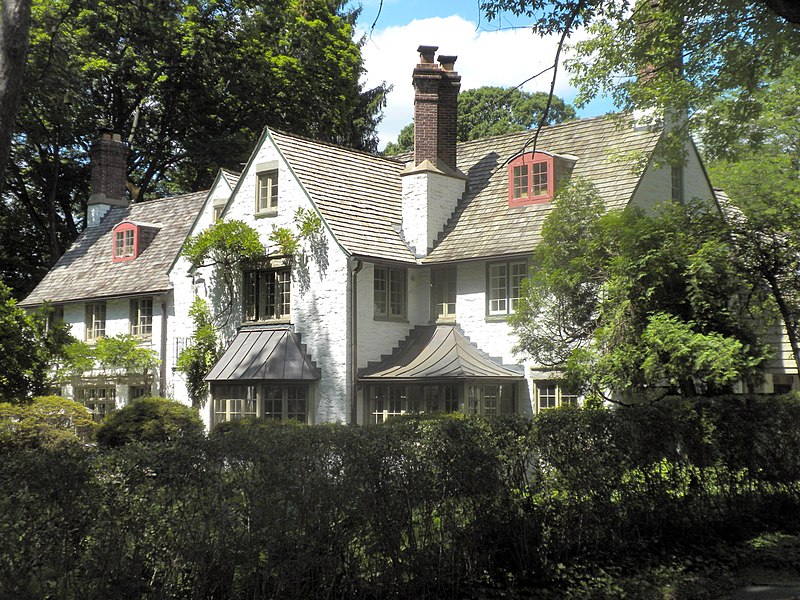 Violet Oakley Studio on the NRHP since September 13, 1977. At 627 St. George's Road in Mount Airy neighborhood of NW Philadelphia. Pennsylvania Historical and Museum Commission marker is in front of this house, 621. The next house on the street is 631. There is a private drive between the 2, so the actual studio may be behind this building (if the apparent contradiction of the sources is forced to be resolved)( Read more... )
Source:
en.wikipedia.org/wiki/Violet_Oakley( Further Readings )More Real Life Romances at my website: www.elisarolle.com![[personal profile]](https://www.dreamwidth.org/img/silk/identity/user.png)
 Nicole Kimberling lives in Bellingham, Washington with her partner, Dawn Kimberling, two bad cats as well as a wide and diverse variety of invasive and noxious weeds. Her first novel, Turnskin, won the Lambda Literary Award for Science Fiction, Fantasy and Horror. She is also the author of the Bellingham Mysteries.
 Turnskin by Nicole Kimberling
 Hell Cop by Astrid Amara, Nicole Kimberling and Ginn Hale

 Vivian Boyack (born 1923) and Alice ‘Nonie’ Dubes (born 1924) The women met in their hometown of Yale, Iowa, while growing up. Then they moved to Davenport in 1947 where Boyack taught school and Dubes did payroll work. ‘We’ve had our ins and outs, but that’s how it goes’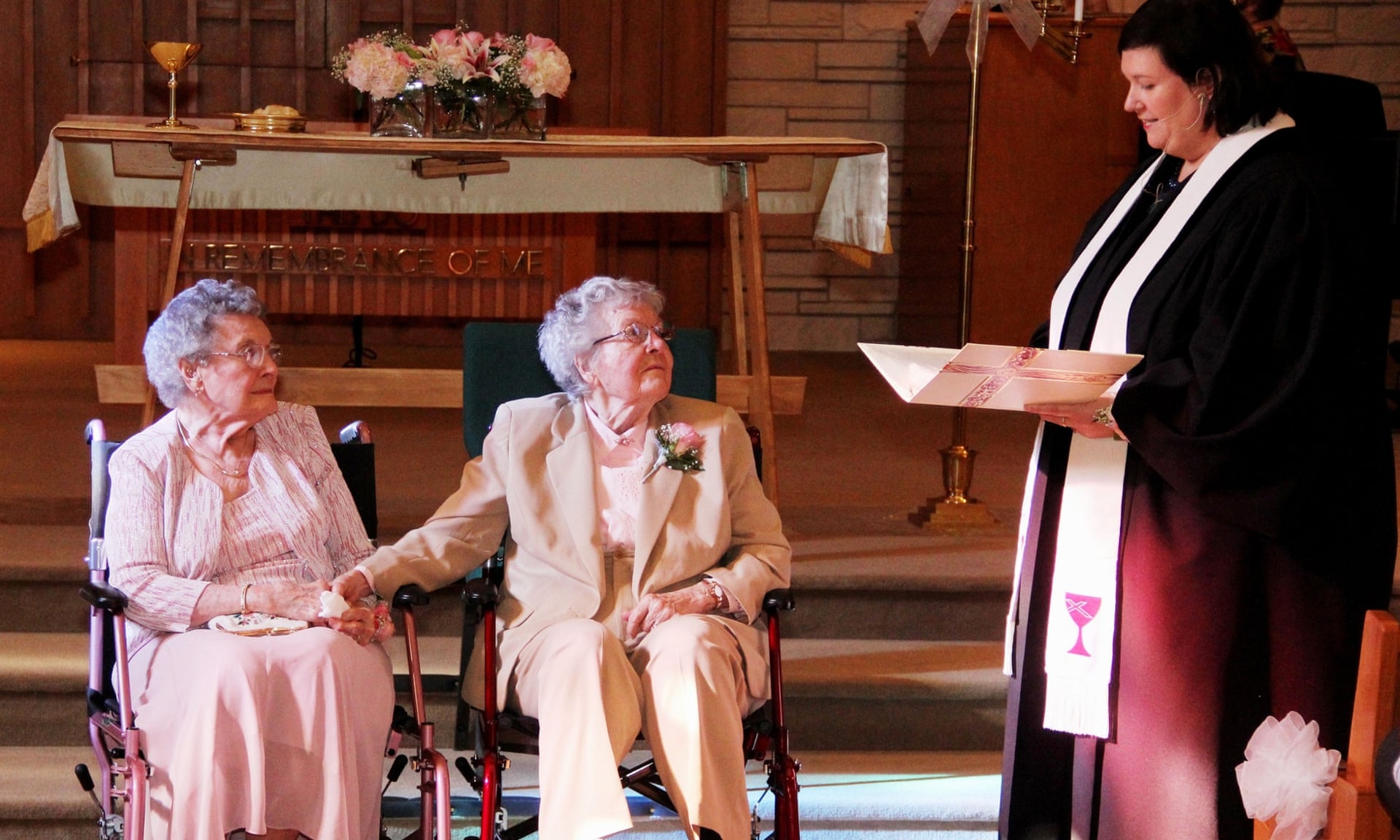

 "At this point — early in the seventeenth century — women step into the picture. The earliest example I know of two women being buried side by side in this way is the monument to Ann Chitting and her friend Mary Barber (from 1606) in the church of St James in Bury in Suffolk." Alan Bray
 James Conrad "Jim" Verraros (born February 8, 1983) is an American singer/entertainer and native of Crystal Lake, Illinois who is most notable for being one of the top 10 finalists in the first season of American Idol. Because he was raised by deaf parents, he is fluent in American Sign Language.
 Verraros released his album Unsaid and Understood (2004) through the indie label Red Queen Music - Sound Axis. It won the 2004 Outmusic Award for Outstanding New Recording - Debut Male.
 Jacques Fath (born Maisons-Laffitte, France, 6 September 1912 – Paris, France, 13 November 1954) was a French fashion designer who was considered one of the three dominant influences on postwar haute couture, the others being Christian Dior and Pierre Balmain.

 Days of Love: Celebrating LGBT History One Story at a Time by Elisa Rolle
 Jane Addams (September 6, 1860 – May 21, 1935) was a pioneer settlement worker, founder of Hull House in Chicago, public philosopher, sociologist, author, and leader in woman suffrage and world peace. Beside presidents such as Theodore Roosevelt and Woodrow Wilson, she was the most prominent reformer of the Progressive Era and helped turn the nation to issues of concern to mothers, such as the needs of children, public health, and world peace. She said that if women were to be responsible for cleaning up their communities and making them better places to live, they needed the vote to be effective in doing so. Addams became a role model for middle-class women who volunteered to uplift their communities. She is increasingly recognized as a member of the American pragmatist school of philosophy. In 1931 she became the first American woman to be awarded the Nobel Peace Prize. Throughout her life Addams was close to many women and was very good at eliciting the involvement of women from different classes in Hull House's programs.
 Her closest adult companion and friend was Mary Rozet Smith (December 23, 1868 - 1934), who supported Addams's work at Hull House, and with whom she shared a romantic friendship. Together they owned a summer house in Bar Harbor, Maine.
 Ellen Gates Starr (March 19, 1859, near Laona, Illinois – February 10, 1940, in Suffern, New York) was an American social reformer and activist. (P:
 Days of Love: Celebrating LGBT History One Story at a Time by Elisa Rolle
 Thomas Hermanns (born 5 March 1963) is a German TV-presenter, director, TV-author and comedian. He is known for his comedy-show Quatsch Comedy Club. Hermanns has been in a relationship for 14 years with Wolfgang Macht. On 6 September 2008 Hermanns and Macht married.
 Hermanns has written and produced different comedy shows on TV, including Zapped (1998), Back to Life (2000) and Paranoid (2004) for Michael Mittermeier, Gayle Tufts and Cora Frost. Hermanns was a director for Grease and Es fährt ein Zug nach Nirgendwo. Hermanns wrote for the TV series Lukas (1997–1999), Meine beste Freundin (2000) with Mariele Millowitsch and Doris Kunstmann and for Sing, wenn du kannst! (2002) at the theatre Schmidts Tivoli in Hamburg.
 For the GRL in San Diego, October 15-18, 2015
 Andrew's Promise by Nic Starr
 His Soldier by Anna Lee