![[personal profile]](https://www.dreamwidth.org/img/silk/identity/user.png)
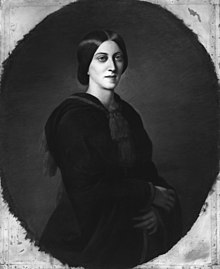 Adelaide Anne Procter (30 October 1825 – 2 February 1864) was an English poet and philanthropist. She worked prominently on behalf of unemployed women and the homeless, and was actively involved with feminist groups and journals. Procter never married, and some of her poetry has prompted speculation that she was a lesbian. She suffered from ill health, possibly due to her charity work, and died of tuberculosis at the age of 38.
Procter's literary career began when she was a teenager; her poems were primarily published in Charles Dickens's periodicals Household Words and All the Year Round and later published in book form. Her charity work and her conversion to Roman Catholicism appear to have strongly influenced her poetry, which deals most commonly with such subjects as homelessness, poverty, and fallen women.
Procter was the favourite poet of Queen Victoria. Her poetry went through numerous editions in the 19th century; Coventry Patmore called her the most popular poet of the day, after Alfred, Lord Tennyson. Her poems were set to music and made into hymns, and were published in the United States and Germany as well as in England. Nonetheless, by the early 20th century her reputation had diminished, and few modern critics have given her work attention. Those who have, however, argue that Procter's work is significant, in part for what it reveals about how Victorian women expressed otherwise repressed feelings.
( Read more... )
Source: https://en.wikipedia.org/wiki/Adelaide_Anne_Procter
 Charlotte Saunders Cushman (July 23, 1816 – February 18, 1876) was an American stage actress. (P: ©Thomas Sully (1783- 1872)/ Library Company of Philadelphia. Bequest of Anne Hampton Brewster, 1892. Charlotte Saunders Cushman, “of the Walnut Street Theater,” 1843 (©4))
She was a descendant in the eighth generation from Pilgrim Robert Cushman. Robert Cushman brought the family name to the United States on the Mayflower as a leader and great advocate for emigration to America. He became a preacher in the colonies, and was known to have given the first sermon in America. Her father, Elkanah, rose from poverty to be a successful West Indian merchant, but lost his fortune, and died, leaving his family in straitened circumstances. Charlotte was a remarkably bright, sportive child, excelling her schoolmates and developing a voice of remarkable compass and richness, with a full contralto register. Two friends of her father, one of them John Mackay (Mackey?), in whose piano factory Jonas Chickering was then foreman, provided her with the best musical instruction. Cushman was forced to take on serious responsibilities at a very young age. At the age of thirteen, her father underwent serious financial troubles and shortly after died, leaving his family with nearly nothing. This caused Charlotte to find her way to bring income to her family. Though Cushman was an incredibly great student and achieved much academically, she left school to pursue a career in the opera.
When Mrs. Joseph Wood visited Boston in 1834, Capt. Mackay introduced Cushman, who sang with her in two of her concerts. Through Mrs. Wood's influence she became a pupil of James G. Maeder, a lady's musical director, and under his instruction made her first appearance in opera in the Tremont Theatre as the Countess Almaviva in The Marriage of Figaro with great success, and her second as Lucy Bertram in Guy Mannering. She went with his company to New Orleans, where her voice, which had been strained by the soprano parts assigned to her, suddenly failed. Seeking the counsel of James H. Caldwell, manager of the principal theatre of New Orleans, she was advised by him and by Barton, the tragedian, to become an actress, and given the part of Lady Macbeth to study, in which she made her appearance with complete success in 1835.

Charlotte Saunders Cushman and Miss Matilda Hays, Artist: Josiah Johnson Hawes (American, Wayland, Massachusetts 1808–1901 Crawford Notch, New Hampshire) Date: ca. 1850 Medium: Daguerreotype Dimensions:21.6 x 16.5 cm (8 1/2 x 6 1/2 in.) Credit Line: Gift of I. N. Phelps Stokes, Edward S. Hawes, Alice Mary Hawes, and Marion Augusta Hawes, 1937 (Holman's Print Shop, Boston), Metropolitan Museum of Art
Charlotte Saunders Cushman was an American stage actress. In 1848, Cushman met journalist, writer and part-time actress Matilda Hays. In 1854, Hays left Cushman for lesbian sculptor Harriet Hosmer. Hays eventually returned to live with Cushman, but by late 1857, Cushman was secretly involved with sculptor Emma Stebbins. Stebbins best-known work is the Angel of the Waters (1873), also known as Bethesda Fountain, located on the Bethesda Terrace in Central Park, New York.
( Read more... )
Source: http://en.wikipedia.org/wiki/Charlotte_Saunders_Cushman
 Emma Stebbins (1 September 1815 — 25 October 1882) was among the first notable American woman sculptors. (Picture: Emma Stebbins (1815 - 1882 ), US Sculptor and lesbian pioneer; Stebbins best known work is the Angel of the Waters (1873), also known as Bethesda Fountain, located on the Bethesda Terrace in Central Park, New York)
Stebbins was born and died in New York City. Raised in a wealthy New York family, she was encouraged by her family in her pursuit of art from an early age. In 1857, sponsored by her brother Col. Henry G. Stebbins, head of the New York Stock Exchange, she moved to Rome where she moved in with sculptor Harriet Hosmer, who had established herself there in 1852. She studied under John Gibson an English neoclassicist working there at that time. In Rome she fell in love with actress Charlotte Saunders Cushman, and quickly became involved in the bohemian and feminist lesbian lifestyle, which was more tolerated there than it would have been back in New York.
Cushman was confident, strong, and charismatic, and recently recovering from a break up following a ten-year relationship with the actress Matilda Hays. Cushman and Stebbins began traveling together, immediately taking a trip to Naples. Upon their return, they began spending time in a circle that included African American/Native American sculptor Edmonia Lewis, many celebrities, and fellow lesbians that included Harriet Hosmer. In this environment, the women flourished without regard for showing outward affection for one another.

Bethesda Fountain by Elisa Rolle, October 2012
Emma Stebbins was among the first notable American woman sculptors. Stebbins best known work is the Bethesda Fountain, located on the Bethesda Terrace in Central Park, New York. In 1857 she moved to Rome and fell in love with actress Charlotte Saunders Cushman. In 1869, Cushman was treated for breast cancer. Stebbins devoted all her time during that ordeal to nursing her lover, ignoring her work during the next two years. Cushman died of pneumonia in 1876. Stebbins died in New York in 1882.
( Read more... )
Source: http://en.wikipedia.org/wiki/Emma_Stebbins
 Matilda Mary Hays (8 September 1820 – 3 July 1897) was a 19th-century English writer, journalist and part-time actress. With Elizabeth Ashurt, Hays translated several of George Sand's works into English. She co-founded the English Woman's Journal. Her love interests included the actress Charlotte Saunders Cushman, with whom she had a 10-year relationship, and the poet Adelaide Anne Procter.
Matilda Hays was born in St Pancras London on 8 September 1820, the daughter of corn merchant John Hays (1768–1862) and his wife Elizabeth. Hays came from a long line of Thames lightermen. Hays was identified as a Creole or half Creole; if this is so, at most she can only have been half Creole through her mother; her father's origins are Londoners going back at least three generations. She wrote articles for periodicals, often regarding women's issues, starting about 1838. The periodicals included The Mirror and Ainsworth's Magazine. (P: Adelaide Anne Procter, Undated portrait by Emma Gaggiotti Richards)
Hays, influenced by George Sand, was a journalist and novelist who was "determined to use her writing to improve the condition of women." In her novel Helen Stanley, Hays wrote that until "Women teach their daughters to respect themselves,... to work for their daily bread, rather than prostitute their persons and hearts" in marriages, women would not have secure financial and social futures.
At a period in time when George Sand's free-love and independent lifestyle was quite unusual for a 19th-century woman, Hays and her friend, Elizabeth Ashurst were "broad-minded" and intrigued by the political and social messages addressed in Sand's books. Hays had received support and encouragement from William Charles Macready and George Henry Lewes to translate Sand's novels into English. Both wrote to Sands encouraging the arrangement and a friend of Hays, chaplain Edmund Larken provided funding for the enterprise.
( Read more... )
Source: en.wikipedia.org/wiki/Matilda_Hays
 Days of Love: Celebrating LGBT History One Story at a Time by Elisa Rolle
Paperback: 760 pages
Publisher: CreateSpace Independent Publishing Platform; 1 edition (July 1, 2014)
Language: English
ISBN-10: 1500563323
ISBN-13: 978-1500563325
CreateSpace Store: https://www.createspace.com/4910282
Amazon (Paperback): http://www.amazon.com/dp/1500563323/?tag=e
Amazon (Kindle): http://www.amazon.com/dp/B00MZG0VHY/?tag=e
Days of Love chronicles more than 700 LGBT couples throughout history, spanning 2000 years from Alexander the Great to the most recent winner of a Lambda Literary Award. Many of the contemporary couples share their stories on how they met and fell in love, as well as photos from when they married or of their families. Included are professional portraits by Robert Giard and Stathis Orphanos, paintings by John Singer Sargent and Giovanni Boldini, and photographs by Frances Benjamin Johnson, Arnold Genthe, and Carl Van Vechten among others. “It's wonderful. Laying it out chronologically is inspired, offering a solid GLBT history. I kept learning things. I love the decision to include couples broken by death. It makes clear how important love is, as well as showing what people have been through. The layout and photos look terrific.” Christopher Bram “I couldn’t resist clicking through every page. I never realized the scope of the book would cover centuries! I know that it will be hugely validating to young, newly-emerging LGBT kids and be reassured that they really can have a secure, respected place in the world as their futures unfold.” Howard Cruse “This international history-and-photo book, featuring 100s of detailed bios of some of the most forward-moving gay persons in history, is sure to be one of those bestsellers that gay folk will enjoy for years to come as reference and research that is filled with facts and fun.” Jack Fritscher


 Alfred Cornelius Lynch (26 January 1931 – 16 December 2003) was an English actor on stage, film and television.
 In 1958 he joined the Royal Court Theatre and acted in a number of plays. After 1960 his career moved more into film and television, for example appearing with Sean Connery in the 1961 film On the Fiddle and the 1965 film The Hill. He also appeared in the 1968 adaptation of The Sea Gull, and the 1990 film The Krays. Some of his later television credits include reading children's stories on Jackanory, Manhunt, Going Straight, Pie in the Sky, and the Doctor Who serial The Curse of Fenric as Commander Millington.
 Days of Love: Celebrating LGBT History One Story at a Time by Elisa Rolle
 Alice B. Toklas (April 30, 1877 – March 7, 1967) was an American-born member of the Parisian avant-garde of the early 20th century. (Picture: Alice B. Toklas, photographed by Carl Van Vechten, 1949)


 Gertrude Stein (February 3, 1874 – July 27, 1946) was an American writer, poet and art collector who spent most of her life in France. (Picture: Gertrude Stein, 1935, by Carl Van Vechten)
 Days of Love: Celebrating LGBT History One Story at a Time by Elisa Rolle
 The first same-sex marriage in Spain took place after the Roman Imperial era on 8 June 1901. (Marcela and Elisa at Oporto)
 Days of Love: Celebrating LGBT History One Story at a Time by Elisa Rolle
 Glencairn Alexander "Glen" Byam Shaw, CBE (13 December 1904 – 29 April 1986) was an English actor and theatre director, known for his dramatic productions in the 1950s and his operatic productions in the 1960s and later. He was the son of J. Byan Shaw, an artist. Created CBE in 1954, he also received the Hon DLitt of the University of Birmingham in 1959. (P: Byam Shaw in his early years as an actor)
 In the 1920s and 1930s Byam Shaw was a successful actor, both in romantic leads and in character parts. He worked frequently with his old friend John Gielgud. After working as co-director with Gielgud at the end of the 1930s, he preferred to direct rather than act. He served in the armed forces during the Second World War, and then took leading directorial posts at the Old Vic, the Shakespeare Memorial Theatre and Sadler's Wells (later known as the English National Opera).
 Siegfried Loraine Sassoon CBE MC (8 September 1886 – 1 September 1967) was an English poet, author and soldier. Decorated for bravery on the Western Front, he became one of the leading poets of the First World War. His poetry both described the horrors of the trenches, and satirised the patriotic pretensions of those who, in Sassoon's view, were responsible for a pointless war. He later won acclaim for his prose work, notably his three-volume fictionalised autobiography, collectively known as the "Sherston Trilogy". (P: ©William Edward Gray (1864-1935), after Glyn Philpot (1884-1937)/NPG D40553. Siegfried Loraine Sassoon, 1917 (©4))
 Stephen James Napier Tennant (21 April 1906 – 28 February 1987) was a British aristocrat known for his decadent lifestyle. It is said, albeit apocryphally, that he spent most of his life in bed. (P: ©Foulsham & Banfield/NPG x132862. Stephen Tennant, ca. 1920s (©19))
 Days of Love: Celebrating LGBT History One Story at a Time by Elisa Rolle
 Jeff Miner is the pastor of Jesus Metropolitan Community Church in Indianapolis, Indiana. He was raised in fundamentalist independent Baptist churches, and received his undergraduate degree from Bob Jones University.

 For the GRL in San Diego, October 15-18, 2015
 Kid by Doreen Perrine